In the Media
Thursday, February 12th 2026
Earnings Straddles Are Having Their Moment
Strong realized moves and shifting volatility expectations have produced one of the most favorable earnings seasons for straddle buyers in years.
Summary
This earnings season has been notably favorable for straddle buyers, with options straddles generating an average return of about 45%, a significant shift from the previous quarters. Factors contributing to this include greater dispersion in company performance, increased sensitivity to guidance, and macro uncertainty. The performance of straddles is measured by comparing implied earnings moves to actual stock moves, revealing that actual moves have consistently exceeded expectations. This shift in earnings volatility suggests a change in market conditions, benefiting straddle buyers significantly.
This earnings season has been unusually favorable for straddle buyers.
Over the past four weeks, options straddles on U.S. companies reporting earnings have generated an average return of approximately 45%. That compares with an average return of roughly negative 2% across the last twelve quarters.
That is a meaningful shift. So what changed?
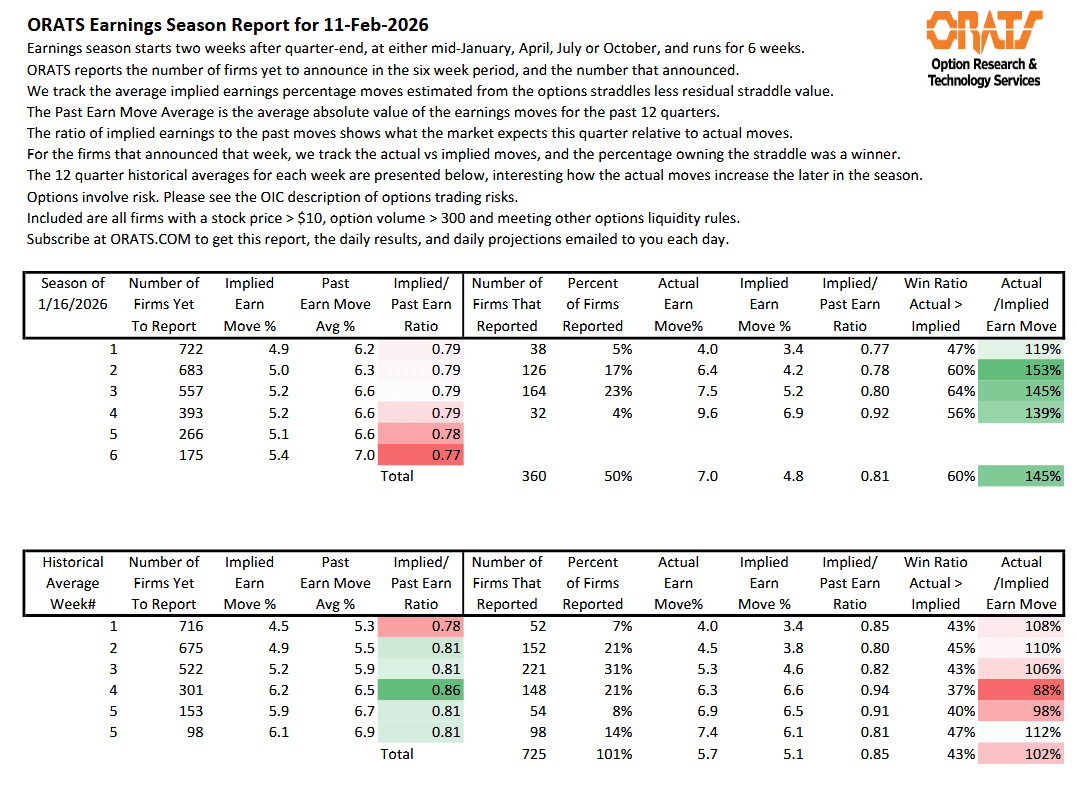
ORATS earnings season data as of February 11, 2026, showing implied versus actual earnings moves, implied-to-past-move ratios, and straddle win rates. Recent weeks highlight realized moves exceeding implied expectations, with straddle buyers averaging approximately 45% returns compared to a negative 12-quarter historical average.
Why Straddles Are Working Again
As Matt Amberson noted in comments to Reuters:
"Earnings announcements are important again. Everyone wants to know how companies are faring in this economic environment and what sort of guidance companies expect. If the news is good, we see large up moves. If news is bad, stock prices are getting punished."
Straddles benefit when actual stock moves exceed what options markets priced in ahead of earnings. In recent years, implied earnings moves often overstated realized volatility. Traders paid up for event risk, and the moves frequently fell short.
This quarter has looked different. Actual earnings moves have been consistently larger than the implied move embedded in the pre-earnings straddle. That gap between implied and realized volatility is what has driven the strong returns.
Several factors appear to be contributing:
- Greater dispersion in company performance
- Increased sensitivity to forward guidance
- Macro uncertainty translating into sharper single-name reactions
In short, earnings are moving stocks in a way that resembles earlier high-uncertainty environments.
How ORATS Measures Earnings Straddle Performance
ORATS tracks earnings straddle performance by comparing the implied earnings move, derived from the at-the-money straddle minus residual time value, against the actual absolute stock move following the announcement. This methodology isolates the earnings event itself from broader term structure effects.
Earnings season starts approximately two weeks after quarter-end, beginning in mid-January, April, July, or October, and runs for six weeks. ORATS reports the number of firms yet to announce during each period, tracks implied earnings percentage moves estimated from options straddles, and compares them against the trailing 12-quarter average of actual absolute earnings moves.
A straddle is considered a “winner” when the actual stock move exceeds the implied move priced into the options, meaning the position would have been profitable at expiration.
For firms announcing over the past four weeks, filtered for stock prices above $10, daily option volume exceeding 300 contracts, and meeting additional liquidity thresholds, the win rate for straddle buyers has meaningfully exceeded the 12-quarter historical average.
The Implied-to-Actual Ratio
The ratio of implied earnings moves to the trailing 12-quarter average of actual moves provides a gauge of market expectations. When this ratio runs high, options are pricing in elevated risk relative to history. When it runs low, options may be underpricing the event.
This season, even with implied moves reflecting heightened uncertainty, realized moves have outpaced them. That combination has rewarded straddle buyers in a way that has not been common in recent quarters.
Historically, actual earnings moves tend to increase as the season progresses. Early reporters, often larger and more predictable companies, tend to produce smaller surprises. Later in the cycle, smaller and mid-cap names with less analyst coverage can generate outsized moves. This quarter has followed that pattern, but with amplified magnitude across multiple weeks.
Why This Matters
Earnings seasons rotate between regimes.
There are periods when implied volatility consistently overprices earnings risk, and straddle sellers collect premium. There are periods, like the current one, when realized dispersion surprises to the upside and straddle buyers profit.
For traders and funds that systematically evaluate event risk, the key question is whether implied pricing is aligned with historical earnings behavior and current macro conditions. This quarter, that alignment has clearly shifted.
ORATS publishes weekly earnings season summaries tracking the number of firms yet to report, implied versus actual moves, and straddle win rates. Monitoring these metrics helps identify when earnings volatility regimes begin to change.
The recent data is a reminder that earnings volatility can reprice quickly, and when it does, the performance profile of common event strategies can change just as fast.
Disclaimer:
The opinions and ideas presented herein are for informational and educational purposes only and should not be construed to represent trading or investment advice tailored to your investment objectives. You should not rely solely on any content herein and we strongly encourage you to discuss any trades or investments with your broker or investment adviser, prior to execution. None of the information contained herein constitutes a recommendation that any particular security, portfolio, transaction, or investment strategy is suitable for any specific person. Option trading and investing involves risk and is not suitable for all investors.
All opinions are based upon information and systems considered reliable, but we do not warrant the completeness or accuracy, and such information should not be relied upon as such. We are under no obligation to update or correct any information herein. All statements and opinions are subject to change without notice.
Past performance is not indicative of future results. We do not, will not and cannot guarantee any specific outcome or profit. All traders and investors must be aware of the real risk of loss in following any strategy or investment discussed herein.
Owners, employees, directors, shareholders, officers, agents or representatives of ORATS may have interests or positions in securities of any company profiled herein. Specifically, such individuals or entities may buy or sell positions, and may or may not follow the information provided herein. Some or all of the positions may have been acquired prior to the publication of such information, and such positions may increase or decrease at any time. Any opinions expressed and/or information are statements of judgment as of the date of publication only.
Day trading, short term trading, options trading, and futures trading are extremely risky undertakings. They generally are not appropriate for someone with limited capital, little or no trading experience, and/ or a low tolerance for risk. Never execute a trade unless you can afford to and are prepared to lose your entire investment. In addition, certain trades may result in a loss greater than your entire investment. Always perform your own due diligence and, as appropriate, make informed decisions with the help of a licensed financial professional.
Commissions, fees and other costs associated with investing or trading may vary from broker to broker. All investors and traders are advised to speak with their stock broker or investment adviser about these costs. Be aware that certain trades that may be profitable for some may not be profitable for others, after taking into account these costs. In certain markets, investors and traders may not always be able to buy or sell a position at the price discussed, and consequently not be able to take advantage of certain trades discussed herein.
Be sure to read the OCCs Characteristics and Risks of Standardized Options to learn more about options trading.
Related Posts