Market Events
Tuesday, December 23rd 2025
What the Holiday Implied Volatility Term Structure Is Telling Us
Otto Explains Holiday Risk
Summary
The SPX implied volatility term structure indicates concentrated risk around specific trading sessions, particularly during holiday periods. While raw implied volatility appears stable, normalized analysis reveals significant variance concentrated on December 31 due to high-impact labor reports and reduced liquidity. This setup warns traders that low implied volatility levels may mask heightened event-specific risks, emphasizing the importance of understanding term structure shape and timing when assessing market conditions.
At first glance, the SPX implied volatility term structure heading into year-end does not appear particularly unusual.
Across expirations from late December through early January, implied volatility levels sit broadly in the high single digits to low double digits. Day-to-day differences across expirations are measured in tenths of a percent. On the surface, nothing appears meaningfully out of line.
However, when those same implied volatilities are normalized correctly for time, variance, and non-trading days, a very different picture emerges. The options market is currently pricing a large concentration of risk into a specific trading session, rather than signaling a broad shift in the volatility regime.
This type of distortion is most common around holidays, shortened trading weeks, and clustered macro events. And it is exactly the kind of setup where raw implied volatility levels can be misleading.
Raw Implied Volatility Can Hide Concentrated Risk
Looking at unadjusted SPX implied volatility from December 23 through mid-January, front-end IV generally ranges from approximately 9 percent to 11 percent.
In isolation, those numbers do not stand out. Traders scanning the term structure quickly may conclude that volatility is subdued and evenly distributed across expirations.
The problem with that interpretation is that implied volatility does not scale linearly with time. Risk is not distributed evenly across calendar days. And non-trading days are not risk-free simply because markets are closed.
To properly compare implied volatility across expirations, time must be modeled realistically.
Why Time Modeling Matters Around Holidays
At ORATS, time to expiration is not treated as a simple count of calendar days or a binary count of business days.
Instead, time is modeled as a blend.
Trading days carry full weight.
Non-trading days still carry risk, but at a reduced and empirically derived level.
This approach reflects observed market behavior. Weekends, holidays, and overnight gaps consistently exhibit more realized movement than a pure calendar-day model would imply, particularly around macro events and periods of thin liquidity.
Holiday weeks amplify this effect.
Liquidity tends to be thinner. Positioning can become more lopsided. Overnight gaps matter more. As a result, implied volatility relationships often distort around holidays and half-days, even before any scheduled events are considered.
This is why blended time modeling is critical when comparing expirations that straddle long weekends or holiday periods.
The Role of Variance Concentration
Volatility is quoted in percentage terms, but variance, which is the square of volatility, is the quantity that aggregates through time.
When the market expects multiple days’ worth of uncertainty to resolve in a single session, variance becomes concentrated. Small changes in implied volatility can therefore correspond to very large changes in expected risk.
This distinction is central to understanding what the current SPX term structure is signaling.
December 31st: Event Risk Meets Holiday Structure
On Wednesday, December 31st, markets receive multiple high-impact labor-related releases.
Initial Jobless Claims are released at 8:30 a.m. ET, followed shortly by Chicago PMI.
These reports directly influence rate expectations, risk sentiment, and index-level positioning. Importantly, they are scheduled to arrive during a holiday week with reduced trading hours and thinner liquidity.
When ORATS’ volatility models adjust implied volatility for blended time and variance, the result is striking.
Although raw implied volatility rises modestly, the normalized distortion indicates that approximately double the normal daily variance is being priced into that single session.
In other words, the options market is not pricing a gentle increase in uncertainty. It is pricing a significant compression of risk into one trading day.
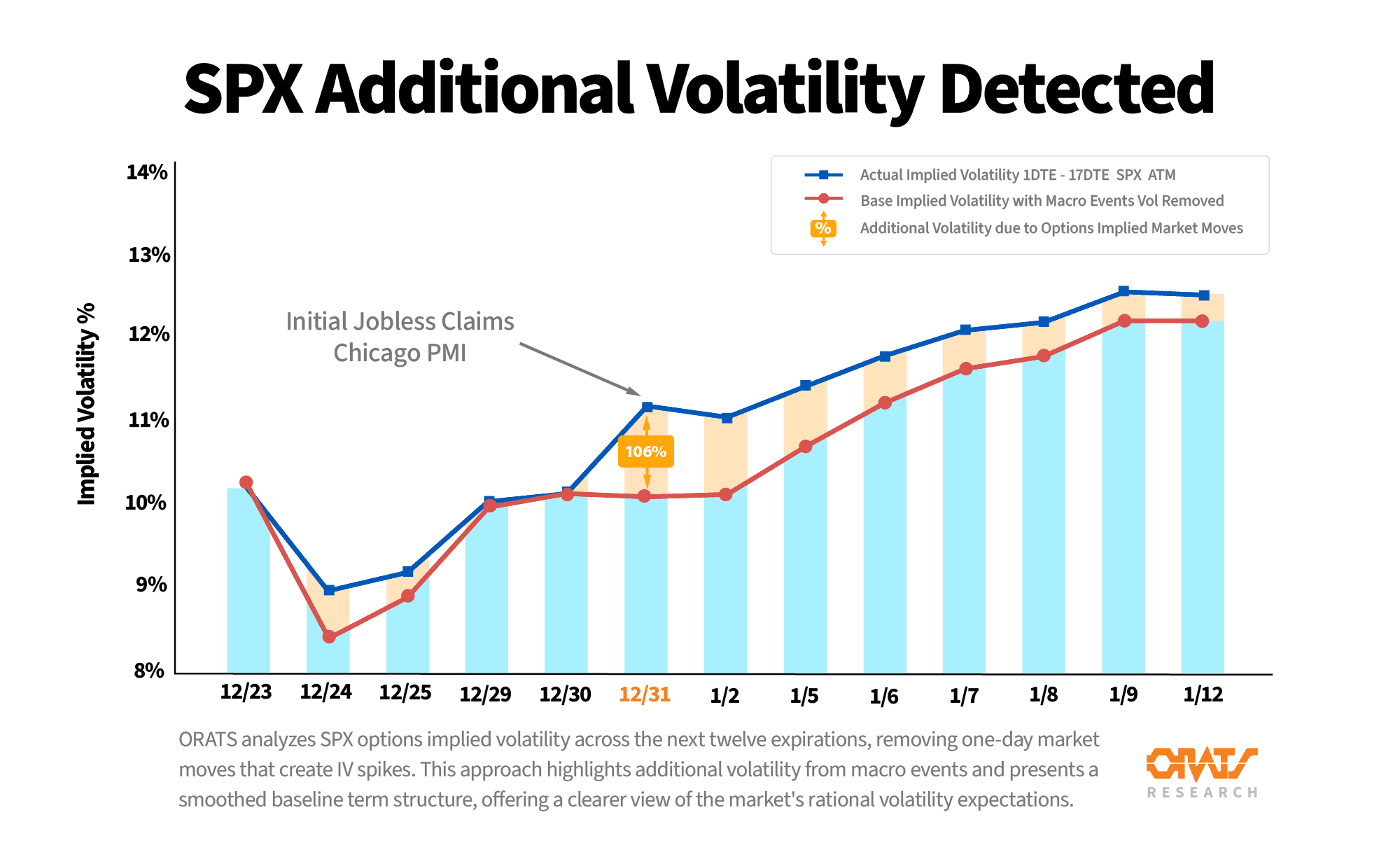
SPX implied volatility across late December and early January, highlighting concentrated event-driven risk around December 31.
Why This Matters for Options Traders
This type of setup highlights why focusing exclusively on implied volatility levels can be dangerous.
A small change in IV does not necessarily imply a small change in risk.
Term structure shape matters more than absolute IV levels.
Calendar placement of risk can dominate strategy outcomes.
Holiday periods and macro clusters are precisely where these effects tend to surface. Traders who ignore variance concentration and blended time effects may misinterpret “low” volatility as benign, when the market is actually signaling heightened event-specific risk.
Reading the Term Structure Correctly
What the current SPX term structure is telling us is not that volatility is broadly elevated. It is telling us that the market is very specific about when risk is expected to occur.
That distinction is critical.
By modeling time realistically, accounting for non-trading days, and normalizing variance appropriately, it becomes possible to see what the options market is actually pricing, rather than what headline IV numbers appear to suggest.
Right now, the market is pricing a lot of risk, and it is placing it very deliberately on the calendar.
Disclaimer:
The opinions and ideas presented herein are for informational and educational purposes only and should not be construed to represent trading or investment advice tailored to your investment objectives. You should not rely solely on any content herein and we strongly encourage you to discuss any trades or investments with your broker or investment adviser, prior to execution. None of the information contained herein constitutes a recommendation that any particular security, portfolio, transaction, or investment strategy is suitable for any specific person. Option trading and investing involves risk and is not suitable for all investors.
All opinions are based upon information and systems considered reliable, but we do not warrant the completeness or accuracy, and such information should not be relied upon as such. We are under no obligation to update or correct any information herein. All statements and opinions are subject to change without notice.
Past performance is not indicative of future results. We do not, will not and cannot guarantee any specific outcome or profit. All traders and investors must be aware of the real risk of loss in following any strategy or investment discussed herein.
Owners, employees, directors, shareholders, officers, agents or representatives of ORATS may have interests or positions in securities of any company profiled herein. Specifically, such individuals or entities may buy or sell positions, and may or may not follow the information provided herein. Some or all of the positions may have been acquired prior to the publication of such information, and such positions may increase or decrease at any time. Any opinions expressed and/or information are statements of judgment as of the date of publication only.
Day trading, short term trading, options trading, and futures trading are extremely risky undertakings. They generally are not appropriate for someone with limited capital, little or no trading experience, and/ or a low tolerance for risk. Never execute a trade unless you can afford to and are prepared to lose your entire investment. In addition, certain trades may result in a loss greater than your entire investment. Always perform your own due diligence and, as appropriate, make informed decisions with the help of a licensed financial professional.
Commissions, fees and other costs associated with investing or trading may vary from broker to broker. All investors and traders are advised to speak with their stock broker or investment adviser about these costs. Be aware that certain trades that may be profitable for some may not be profitable for others, after taking into account these costs. In certain markets, investors and traders may not always be able to buy or sell a position at the price discussed, and consequently not be able to take advantage of certain trades discussed herein.
Be sure to read the OCCs Characteristics and Risks of Standardized Options to learn more about options trading.
Related Posts