Earnings
Tuesday, February 24th 2026
Is NVDA Earnings Volatility Underpriced?
Absolute compression, sector inversion, and what elevated market volatility may be masking
Summary
Nvidia's implied earnings move is currently 5.6%, significantly lower than its historical average of 7.6%, indicating reduced expectations for volatility. This compression may be due to a higher overall market volatility regime, suggesting that event-specific volatility appears less significant. Additionally, Nvidia's implied move is now below the sector average, reversing its historical premium. Possible interpretations include improved predictability of earnings, structural changes in the company's profile, or the influence of elevated baseline volatility. Understanding these dynamics is crucial for accurate analysis of implied earnings volatility.

NVDA overview in the ORATS Dashboard, including current implied volatility and upcoming earnings date.
Nvidia’s upcoming earnings present a useful example of how the options market prices event risk. At first glance, the implied earnings move appears compressed relative to both NVDA’s own history and its typical positioning within the technology sector. Whether that reflects mispricing or a change in expectations requires careful examination of the data.
What the Implied Earnings Move Represents
The implied earnings move is the percentage move the options market is pricing immediately following an earnings announcement. It is derived from options prices, commonly through near-term at-the-money structures surrounding the event.
This number reflects expectations embedded in current pricing. It is not a forecast or a prediction. It is a measurement of how much movement traders are willing to pay for.
ORATS calculates the implied earnings move by isolating the volatility attributable specifically to the earnings event, separating it from the baseline implied volatility embedded across the term structure. That distinction becomes particularly important when the broader volatility environment is elevated.
The Absolute Comparison: 5.6% vs 7.6%
NVDA’s current implied earnings move is 5.6%. Over the past 12 quarters, the average implied earnings move has been 7.6%. NVDA’s actual post-earnings moves have also clustered near that 7.6% level.
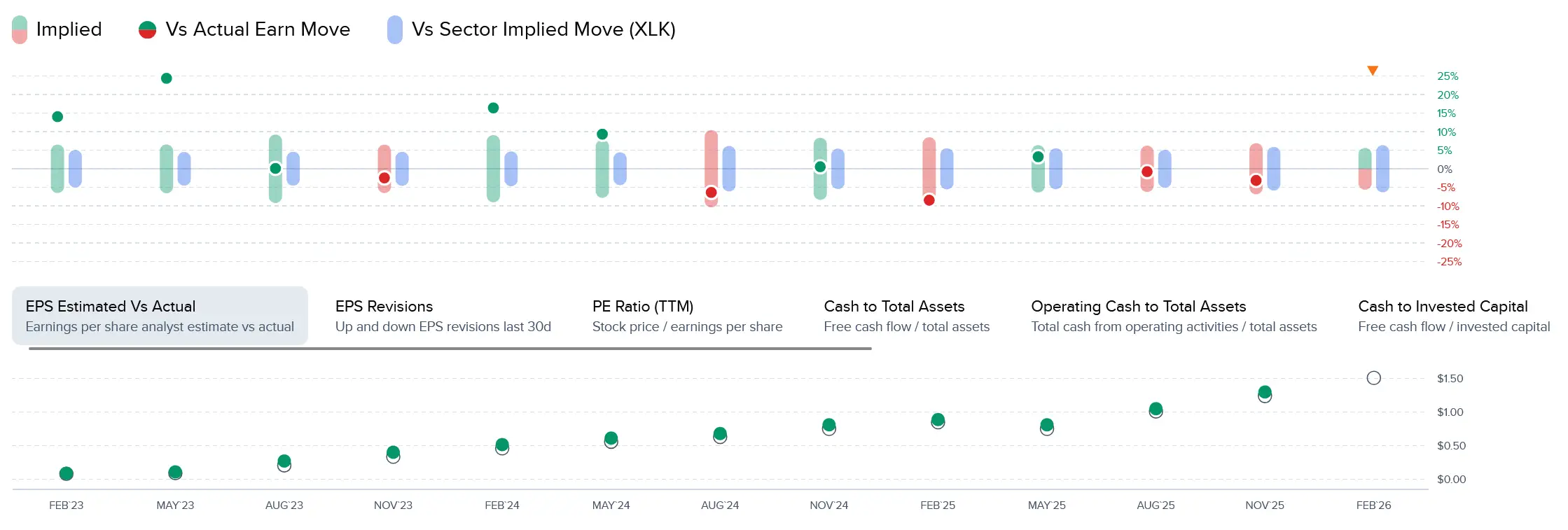
Historical implied and realized earnings moves for NVDA, compared with the XLK sector benchmark. Source: ORATS Dashboard
The difference is meaningful. A 5.6% implied move represents roughly 26% less expected movement than what has typically occurred.
For a company that has regularly delivered significant earnings reactions, that compression stands out. It does not imply the market is incorrect. It does indicate that expectations are currently below what history would suggest.
When pricing departs materially from established patterns, understanding the reason becomes critical.
Why the Implied Move May Be Lower
One likely driver is the broader volatility regime.
Overall market implied volatility remains elevated, particularly in longer-dated options. When the baseline level of implied volatility is already high, event-specific volatility becomes a smaller incremental addition.
Mechanically, the implied earnings move is extracted by comparing near-term options that include the earnings event with longer-term options that do not. If longer-term implied volatility is elevated, the difference between those maturities narrows. The calculated event premium appears smaller, even if uncertainty around earnings has not materially changed.
In practical terms, the volatility floor is higher than usual. Against that backdrop, the earnings component represents a smaller percentage increase.
This is why implied earnings moves cannot be interpreted in isolation. The volatility regime matters.
The Sector-Relative Comparison
Absolute history tells part of the story. Relative positioning provides additional context.
ORATS measures the capitalization-weighted average implied earnings move for XLK, the Technology Select Sector ETF. This creates a sector benchmark against which individual stocks can be compared.
Historically, NVDA’s implied earnings move has averaged 1.5 times the XLK benchmark. In other words, NVDA has typically been priced at a 50% premium to the average large-cap technology name around earnings.
Today, that ratio is 0.9. NVDA’s implied move is approximately 10% below the sector average.
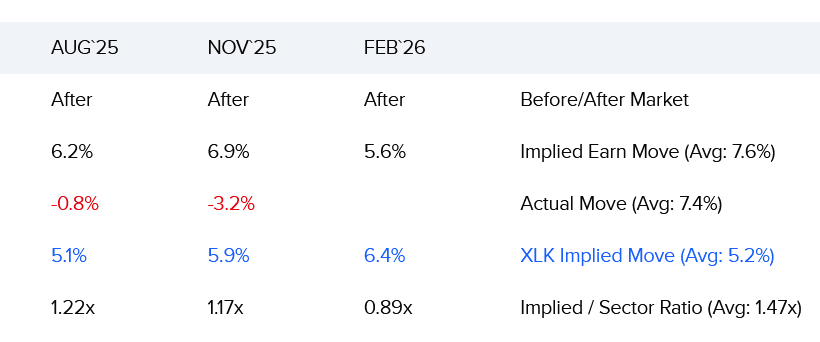
NVDA earnings history showing implied move, realized move, and relative positioning versus the XLK sector benchmark. Source: ORATS Dashboard
That shift is significant. NVDA is not only pricing below its own historical average. It is pricing below how it has historically traded relative to its peers. The long-standing premium has reversed.
The sector comparison confirms the same compression observed in the absolute numbers. NVDA is being treated as less event-driven than it has typically been.
Possible Interpretations
There are several ways to interpret this data.
The market may view NVDA’s earnings profile as more predictable this quarter. Guidance may be clearer, demand visibility stronger, or dispersion of outcomes narrower than in prior periods.
It is also possible that options are inexpensive relative to NVDA’s historical earnings behavior. If realized movement approaches the long-term 7.6% average, current implied pricing would appear conservative.
Another explanation is structural. As NVDA has grown into one of the largest companies in the market, its earnings profile may be perceived as more stable. Large-cap weighting effects and broader institutional ownership can influence volatility characteristics over time.
Finally, some portion of the compression may reflect the elevated baseline volatility regime. When systemic risk is already priced at higher levels, event-specific volatility appears less extreme by comparison.
The data does not prescribe a conclusion. It frames the range of possibilities.
Tools Behind the Analysis
This type of comparison draws on several views available in ORATS: historical implied versus actual move data in the Earnings and News tab, sector-relative ratio calculations, and broader term structure context.
Taken together, these perspectives allow traders to evaluate implied pricing against both a stock’s own history and its position within the current volatility regime.
The objective is not prediction. It is context. When implied volatility diverges from established patterns, structured comparison helps clarify what has changed.
Conclusion
NVDA’s current implied earnings move of 5.6% sits well below its 7.6% historical average. At the same time, its sector-relative premium has flipped from 1.5 times the XLK benchmark to 0.9 times.
That combination is uncommon.
Whether this reflects improved predictability, a structural repricing, or the influence of elevated baseline volatility remains uncertain. What is clear is that the current setup deviates from established patterns.
Implied earnings volatility is not just a standalone percentage. It is a relationship between past behavior, current pricing, sector positioning, and volatility regime.
Interpreting that relationship correctly is essential before drawing conclusions from the headline number.
Disclaimer:
The opinions and ideas presented herein are for informational and educational purposes only and should not be construed to represent trading or investment advice tailored to your investment objectives. You should not rely solely on any content herein and we strongly encourage you to discuss any trades or investments with your broker or investment adviser, prior to execution. None of the information contained herein constitutes a recommendation that any particular security, portfolio, transaction, or investment strategy is suitable for any specific person. Option trading and investing involves risk and is not suitable for all investors.
All opinions are based upon information and systems considered reliable, but we do not warrant the completeness or accuracy, and such information should not be relied upon as such. We are under no obligation to update or correct any information herein. All statements and opinions are subject to change without notice.
Past performance is not indicative of future results. We do not, will not and cannot guarantee any specific outcome or profit. All traders and investors must be aware of the real risk of loss in following any strategy or investment discussed herein.
Owners, employees, directors, shareholders, officers, agents or representatives of ORATS may have interests or positions in securities of any company profiled herein. Specifically, such individuals or entities may buy or sell positions, and may or may not follow the information provided herein. Some or all of the positions may have been acquired prior to the publication of such information, and such positions may increase or decrease at any time. Any opinions expressed and/or information are statements of judgment as of the date of publication only.
Day trading, short term trading, options trading, and futures trading are extremely risky undertakings. They generally are not appropriate for someone with limited capital, little or no trading experience, and/ or a low tolerance for risk. Never execute a trade unless you can afford to and are prepared to lose your entire investment. In addition, certain trades may result in a loss greater than your entire investment. Always perform your own due diligence and, as appropriate, make informed decisions with the help of a licensed financial professional.
Commissions, fees and other costs associated with investing or trading may vary from broker to broker. All investors and traders are advised to speak with their stock broker or investment adviser about these costs. Be aware that certain trades that may be profitable for some may not be profitable for others, after taking into account these costs. In certain markets, investors and traders may not always be able to buy or sell a position at the price discussed, and consequently not be able to take advantage of certain trades discussed herein.
Be sure to read the OCCs Characteristics and Risks of Standardized Options to learn more about options trading.
Related Posts