Trading
Wednesday, July 8th 2026
An AI Options Research Workflow with the IBKR AI Integration
Putting IBKR's new AI integration to work on options, one captured research session from screen to staged instruction.
Summary
The IBKR AI integration lets clients connect Claude, ChatGPT, or Grok to their accounts for plain‑language queries, data retrieval, and trade instruction drafting, while keeping final order approval human; using ORATS options data, the agent can screen for rich‑volatility tickers, decompose earnings impacts, compare implied moves to historical reactions, and present actionable insights, demonstrating how grounded, tool‑driven AI can accelerate options research without executing trades automatically.
By Tyler Cheves, ORATS
Interactive Brokers has introduced something new: clients can now connect Claude, ChatGPT, or Grok directly to an existing IBKR account and work in plain language. Ask about your positions, pull market data, screen for ideas, and have the AI draft trade instructions. The integration is built on the Model Context Protocol (MCP), an open standard for connecting AI assistants to external tools. You authenticate on IBKR's own login screen (the AI platform never sees your credentials), and the AI can then read your account summary, positions, balances, open orders, and trade history, and pull market data subject to your entitlements. What it cannot do is trade. An instruction sits in the AI Instructions tab until you review it and convert it into a live order yourself, and in IBKR's own words, instructions never become orders automatically. Analysis is delegated; authority is not.
That control structure is what makes this generation of AI integration workable where "give the bot your API key" never was, and it opens a real question for options traders: what does it take for an AI agent to do options research well? Options are a harder test than equities. The inputs are perishable, the analytics are full of traps, and a language model on its own knows neither today's implied volatility nor how to read it. What follows is a real session showing the capability at work, with the IBKR integration handling the account side and options analytics from ORATS grounding the analysis.
A morning session, captured live
Steps 1 through 3 below are an actual exchange, captured on the morning of July 8, 2026 with ORATS data and an AI agent driving the tools. Step 4 describes where the workflow goes on the brokerage side. The watchlist is a set of widely traded large-cap names, the data will have changed by the time you read this, and nothing here is a recommendation.
1. Screen. The trader asks in plain English: "Which names on my watchlist have the richest options this morning?" The agent translates that into a query, ranking each name's 30-day implied volatility against a forecast of realized volatility:
orats data delayed-cores --ticker AAPL,AMD,AMZN,GOOGL,META,MSFT,NVDA,TSLA \
  --fields ticker,iv30d,orFcst20d,ivPctile1y \
  --filter-output 'ticker,iv30d,orFcst20d,ivPctile1y,richness=iv30d/orFcst20d' \
  --sort '-(iv30d/orFcst20d)'
That is the only raw command in this article. The exact syntax isn't important; the point is that the agent composes and executes these tool calls itself, and you never leave plain English.
One name jumps out. META's 30-day implied volatility is 28% above the forecast and in the 98th percentile of its own past year. On the surface, that looks like expensive premium.
2. Interrogate the standout. The trader pushes back: "Go deeper on META. Is that premium actually rich, or is something driving it?" The agent pulls the earnings decomposition:
And the story changes. Strip the earnings event out of the 30-day IV and you get 37.9, almost exactly on top of the 38.2 forecast. Earnings are three weeks out, inside the 30-day window, and the market is pricing a 7.4% move on the report. The richness the screen flagged is not mispriced volatility. It is the earnings event, priced explicitly. A short-premium trade here is an earnings bet, not a volatility-mispricing harvest, and the trader should size it (or pass) on those terms.
3. Challenge the thesis. A recent Traders' Insight article, Using the IBKR AI Integration: A Professional Trader's Guide, made the point that AI should challenge your thinking, not confirm it. The trader keeps pushing: "Is a 7.4% implied move high or low for META? Check the last eight reports." The agent pulls the earnings calendar and daily closes, verifies from the announcement-time field that all eight were after-close reports, and computes each next-session reaction:
The eight-quarter average absolute move is 7.0%, right in line with the 7.4% being priced. But the last four reports averaged 10.4%, so against the recent tempo the implied move is arguably modest. The agent doesn't resolve that tension; it surfaces it, with numbers the trader can verify, and the judgment stays where it belongs.
4. Take it to the broker. Through the IBKR integration, the agent checks existing positions, balances, and buying power for correlated exposure, and if the trader still wants the trade, it stages what the integration currently supports as an instruction (single-leg limit and market orders on equities and ETFs, as of this writing). The instruction waits in the AI Instructions tab, where you convert, edit, or delete it. Nothing is submitted on the agent's initiative.
The captured session took about two minutes. A research process that can consume the better part of a morning collapses into one conversational thread, with the trader making every decision that matters.
What made that work: grounding
A language model on its own would have answered step 1 with stale or invented numbers, and it might have missed the earnings distinction entirely even with real data in hand. Options analytics are full of traps: units differ across feeds, IV rank is not IV percentile, and earnings effects contaminate cross-ticker comparisons. Grounding an agent for options work therefore takes two things. It needs tools it must call to get numbers, so it can't improvise them. And it needs the methodology to read what comes back, which is why the agent in step 2 knew that checking ex-earnings IV is the first move when a name screens rich near a report.
The data layer
The session above ran on options analytics from ORATS. The core dataset is a smoothed implied volatility surface fit across the US equity options universe, with constant-maturity summaries, volatility forecasts, earnings-move decomposition, and end-of-day history back to 2007. Deep history is what let step 3 answer from evidence rather than intuition: an agent with fifteen-plus years of data can put any of today's numbers in context and show its work.
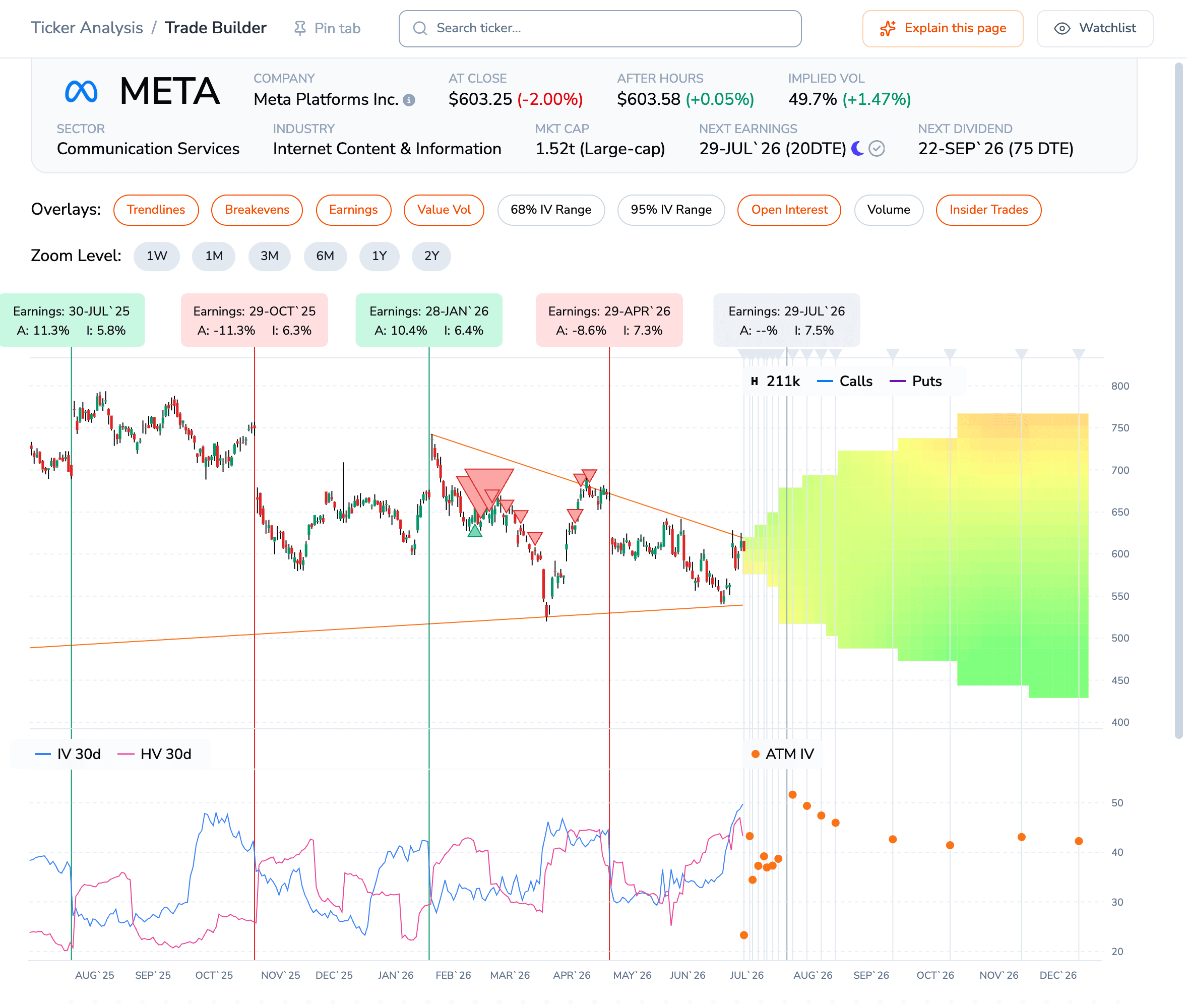
The same analysis viewed in the ORATS dashboard later the same day: META with the July report 20 days out and 30-day implied volatility near 50%. The flags along the chart show each earnings reaction against what the options market had implied (+11.3%, -11.3%, +10.4%, -8.6%), the same moves the agent computed in step 3, with the upcoming report priced at 7.5%.
For AI agents, the data ships in two forms: a command-line interface (@orats/cli) an agent can run directly, and an MCP server that plugs into the same assistant session as the IBKR integration. Alongside the data comes a methodology layer, with field definitions, unit conventions, and signal thresholds installed into the agent's environment, so it reads options data the way a volatility trader would rather than improvising interpretations.
Beyond one session
The compounding value comes from what the AI assistant can do beyond a single chat:
- Memory. The agent keeps your watchlist, strategy preferences, and risk constraints across sessions.
- Parallel research. A brief on eight names can run as eight simultaneous analyses assembled into one morning note.
- Scheduled routines. The screen-and-brief sequence can run before the open. This automation is research only: any order instruction still requires your explicit approval.
- Reusable skills. A workflow refined in conversation can be saved and rerun with one command, so your process becomes versioned, repeatable tooling.
Discipline still wins
None of this changes the fundamentals; it raises the standard for them. Make the agent show the data it retrieved, and spot-check it. Keep sizing, risk limits, and final approval human (the IBKR integration enforces the last of these structurally). Use the AI to argue against your thesis, not for it; the most valuable prompt in the workflow is some version of "tell me why I'm wrong." And treat the output the way you would treat a sharp junior analyst's: useful, fast, and requiring review.
Getting started
On the IBKR side, eligible clients connect Claude, ChatGPT, or Grok by finding the Interactive Brokers connector inside the AI platform and authenticating on IBKR's own login screen. Connecting is free and works with paper trading accounts as well as live ones. On the data side, the ORATS CLI installs with one npm command (npm install -g @orats/cli) and includes the methodology layer and MCP server.
Tyler Cheves is a Product Manager at ORATS (Option Research & Technology Services), a provider of options data, analytics, and backtesting infrastructure. ORATS supplies volatility surfaces, forecasts, and historical options data to institutions, platforms, and individual traders.
Data shown was captured from ORATS on July 8, 2026 and will have changed by the time you read this. All tickers, values, and strategies are referenced for illustration only and do not constitute investment advice or a recommendation. Options involve risk and are not suitable for all investors.
Disclaimer:
The opinions and ideas presented herein are for informational and educational purposes only and should not be construed to represent trading or investment advice tailored to your investment objectives. You should not rely solely on any content herein and we strongly encourage you to discuss any trades or investments with your broker or investment adviser, prior to execution. None of the information contained herein constitutes a recommendation that any particular security, portfolio, transaction, or investment strategy is suitable for any specific person. Option trading and investing involves risk and is not suitable for all investors.
All opinions are based upon information and systems considered reliable, but we do not warrant the completeness or accuracy, and such information should not be relied upon as such. We are under no obligation to update or correct any information herein. All statements and opinions are subject to change without notice.
Past performance is not indicative of future results. We do not, will not and cannot guarantee any specific outcome or profit. All traders and investors must be aware of the real risk of loss in following any strategy or investment discussed herein.
Owners, employees, directors, shareholders, officers, agents or representatives of ORATS may have interests or positions in securities of any company profiled herein. Specifically, such individuals or entities may buy or sell positions, and may or may not follow the information provided herein. Some or all of the positions may have been acquired prior to the publication of such information, and such positions may increase or decrease at any time. Any opinions expressed and/or information are statements of judgment as of the date of publication only.
Day trading, short term trading, options trading, and futures trading are extremely risky undertakings. They generally are not appropriate for someone with limited capital, little or no trading experience, and/ or a low tolerance for risk. Never execute a trade unless you can afford to and are prepared to lose your entire investment. In addition, certain trades may result in a loss greater than your entire investment. Always perform your own due diligence and, as appropriate, make informed decisions with the help of a licensed financial professional.
Commissions, fees and other costs associated with investing or trading may vary from broker to broker. All investors and traders are advised to speak with their stock broker or investment adviser about these costs. Be aware that certain trades that may be profitable for some may not be profitable for others, after taking into account these costs. In certain markets, investors and traders may not always be able to buy or sell a position at the price discussed, and consequently not be able to take advantage of certain trades discussed herein.
Be sure to read the OCCs Characteristics and Risks of Standardized Options to learn more about options trading.
Related Posts