Trading
Monday, July 13th 2026
Bank Earnings and CPI Collide, but the Straddles Don't
Five major banks report in the same window as June CPI, but ORATS data shows the front-week straddles are still overwhelmingly priced around earnings, not the inflation print.
Summary
Banks’ Q2 earnings and the June CPI release on July 14 create a double‑catalyst scenario, but the CPI’s impact on each bank’s earnings variance is small (1.2%‑5.6%), making the straddles primarily a bet on the banks’ own results, with implied earnings moves ranging from about 3.2% to 4.4% and Goldman’s vol notably higher. The SPX implied volatility spikes on CPI day, and traders can isolate pure earnings risk without needing to hedge CPI exposure.
July 13, 2026 By Matt Amberson
Five megacap banks report Q2 earnings before Tuesday's open, July 14, the same pre-market window the June CPI prints at 8:30 ET: JPMorgan, Goldman Sachs, Bank of America, Wells Fargo, and Citigroup. Every front-week straddle spans both, which looks like a double-catalyst bet. It barely is. Decompose each bank's implied earnings move and the CPI-day market-beta overlay is a sliver, 1.2% to 5.6% of the earnings-day variance, and the piece specific to the inflation surprise, net of the day's ordinary noise, is around 1%. The straddle's at least 94% a bet on the bank's own results.
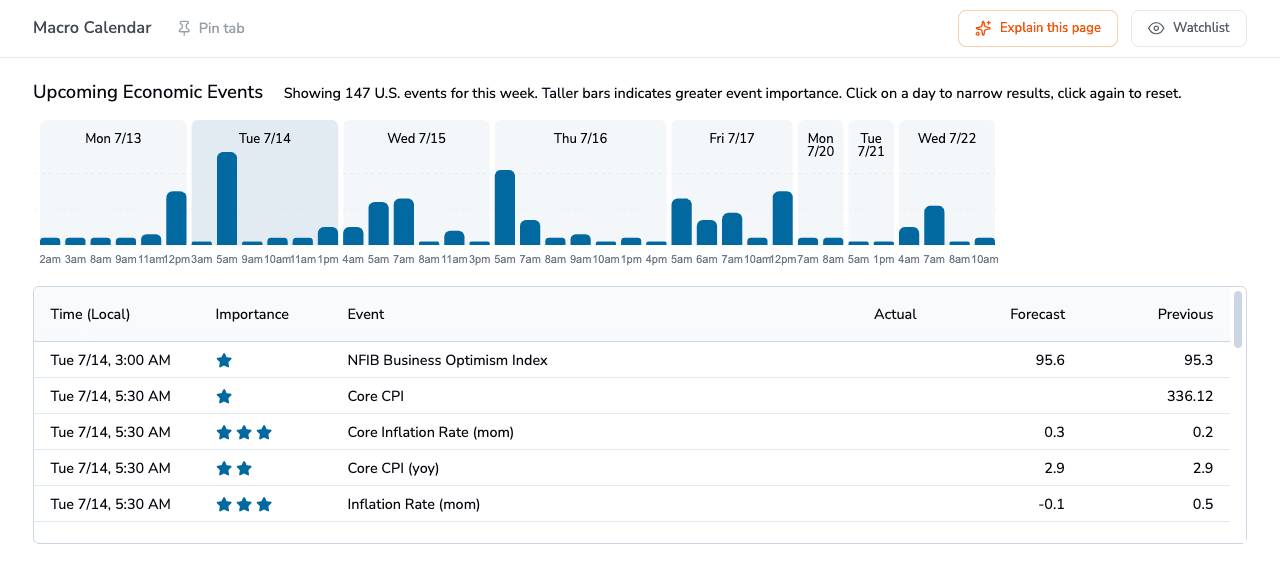
The June CPI cluster prints Tuesday, July 14 at 8:30 ET (local Pacific in the view), the week's biggest scheduled event. Source: ORATS Macro Calendar.
The logic is quadrature. A bank's move is its own idiosyncratic jolt plus its beta share of the market's, and volatilities add as variances, not sums. CPI is market-wide, so beta times the CPI-day market move, squared over the earnings-day variance, is small.
The market is pricing CPI, in the index. At Friday's close the SPX expiry that captures Tuesday priced 8.0% ATM implied vol against 6.2% for Monday's, a 30% jump in the per-expiry vol level. Difference the variance across those daily expiries (/datav2/hist/monies/implied) and the extracted single-day move rises about 11%, to 0.62% for CPI day against 0.55% to 0.58% midweek. Tuesday ties Friday's monthly opex for the week's biggest single day. The inflation risk lives in the SPX weekly straddle.
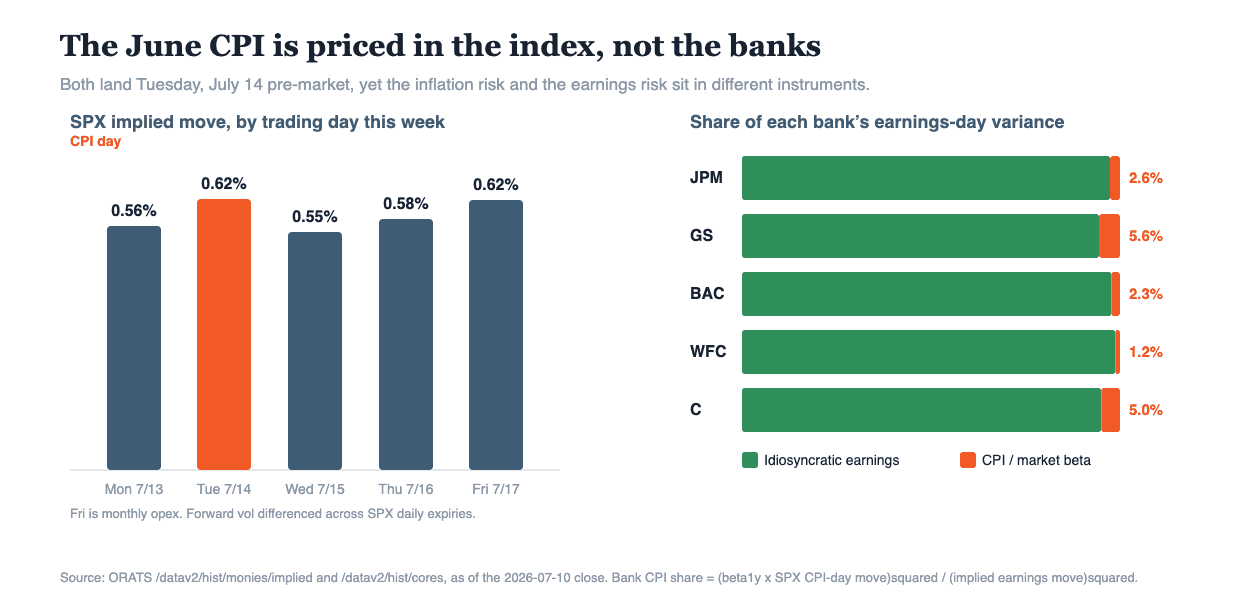
Left: the SPX per-day implied move peaks Tuesday on CPI, tied with Friday's opex. Right: the CPI-day market-beta overlay is 1.2% to 5.6% of each bank's earnings-day variance. Source: ORATS /datav2/hist/monies/implied and /datav2/hist/cores.
The banks themselves price ordinary earnings, not double events. Implied earnings moves are 3.2% for JPMorgan and Bank of America, 3.8% Citigroup, 4.1% Goldman, 4.4% Wells Fargo (impliedEarningsMove, /datav2/hist/cores, July 10 close). Against each name's 12-quarter mean absolute earnings move, that runs 1.1x for Wells Fargo to 1.3x for JPMorgan, the normal earnings volatility risk premium. Only Goldman, at 1.9x, is elevated.
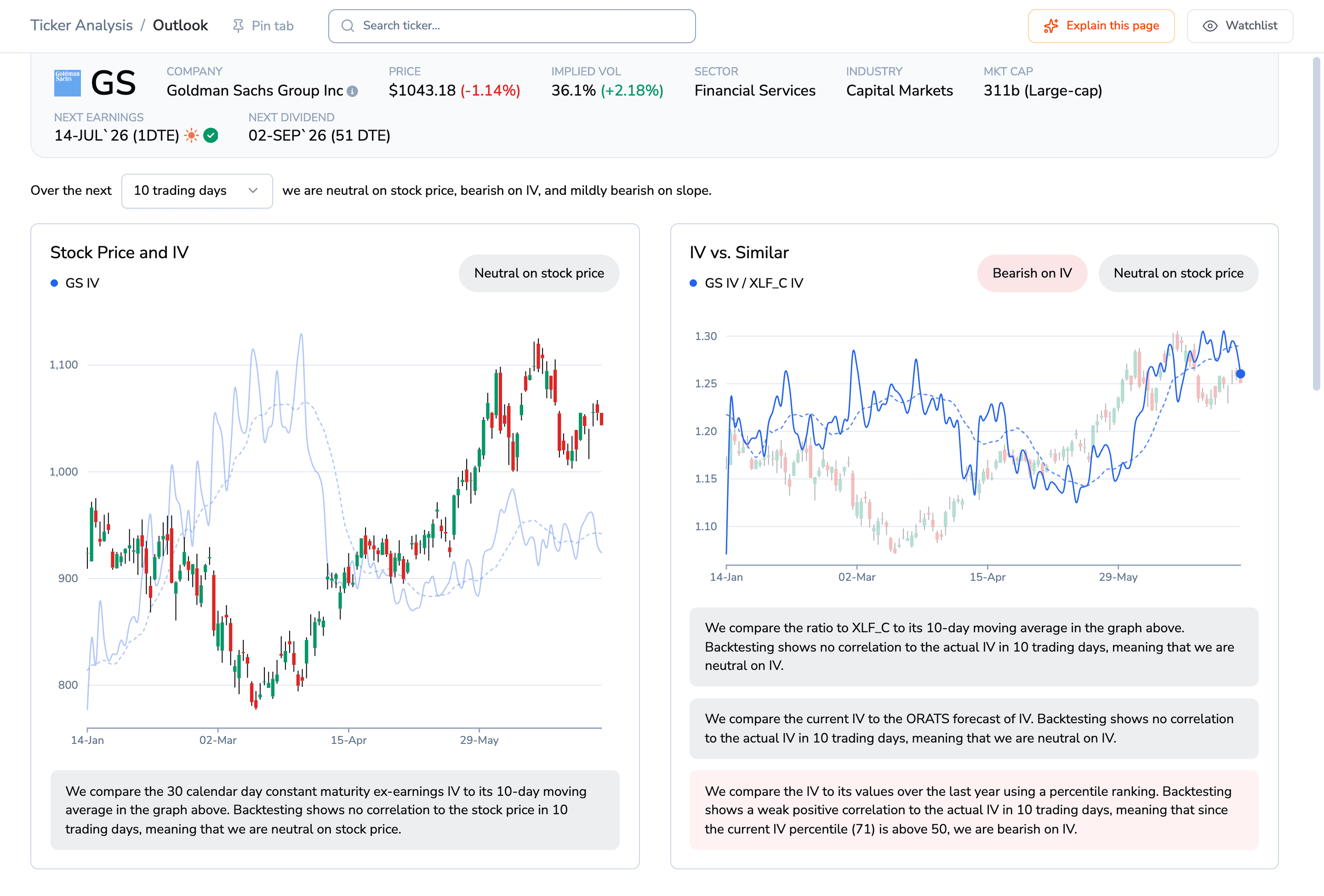
Goldman's Outlook: it reports 14-JUL (1 DTE) pre-market at 36.1% implied vol, the highest of the five banks. Source: ORATS Outlook (live, July 13).
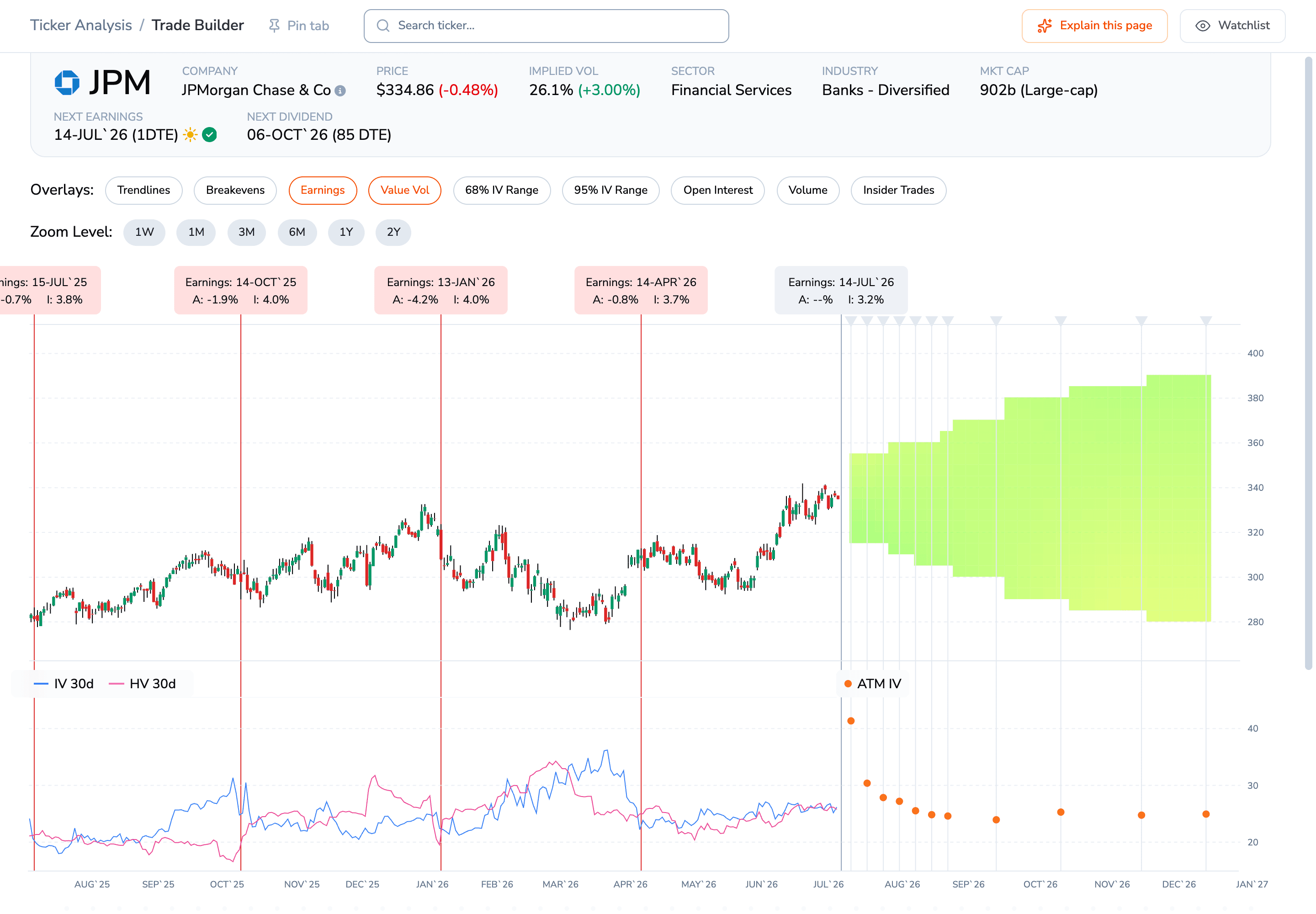
JPMorgan's forward ATM implied-vol dots (orange) sit elevated on the July earnings expiry, then step down to about 24. Source: ORATS Trade Builder (live, July 13).
For a trader, the straddle hands you the bank's earnings almost pure, with no need to beta-hedge the CPI out.
One asterisk: CPI is a rates event, and banks are the most rate-sensitive sector, so a hot print can move net interest margins and bond marks directly, a channel that sits in the curve, not the straddle's beta. So that sliver is a floor, and the SPX weekly's the clean CPI trade. It's a calm-tape read, VIX near 15.
Reproduce it yourself: pull the five banks in the Stock Scanner, read each implied earnings move against its 12-quarter delivered move, then difference the SPX daily expiries around July 14 to watch CPI day stand out.
$JPM $GS $BAC $WFC $C $SPX
#Options #ImpliedVolatility #BankEarnings #CPI #EarningsSeason #VolatilityRiskPremium
Disclaimer:
The opinions and ideas presented herein are for informational and educational purposes only and should not be construed to represent trading or investment advice tailored to your investment objectives. You should not rely solely on any content herein and we strongly encourage you to discuss any trades or investments with your broker or investment adviser, prior to execution. None of the information contained herein constitutes a recommendation that any particular security, portfolio, transaction, or investment strategy is suitable for any specific person. Option trading and investing involves risk and is not suitable for all investors.
All opinions are based upon information and systems considered reliable, but we do not warrant the completeness or accuracy, and such information should not be relied upon as such. We are under no obligation to update or correct any information herein. All statements and opinions are subject to change without notice.
Past performance is not indicative of future results. We do not, will not and cannot guarantee any specific outcome or profit. All traders and investors must be aware of the real risk of loss in following any strategy or investment discussed herein.
Owners, employees, directors, shareholders, officers, agents or representatives of ORATS may have interests or positions in securities of any company profiled herein. Specifically, such individuals or entities may buy or sell positions, and may or may not follow the information provided herein. Some or all of the positions may have been acquired prior to the publication of such information, and such positions may increase or decrease at any time. Any opinions expressed and/or information are statements of judgment as of the date of publication only.
Day trading, short term trading, options trading, and futures trading are extremely risky undertakings. They generally are not appropriate for someone with limited capital, little or no trading experience, and/ or a low tolerance for risk. Never execute a trade unless you can afford to and are prepared to lose your entire investment. In addition, certain trades may result in a loss greater than your entire investment. Always perform your own due diligence and, as appropriate, make informed decisions with the help of a licensed financial professional.
Commissions, fees and other costs associated with investing or trading may vary from broker to broker. All investors and traders are advised to speak with their stock broker or investment adviser about these costs. Be aware that certain trades that may be profitable for some may not be profitable for others, after taking into account these costs. In certain markets, investors and traders may not always be able to buy or sell a position at the price discussed, and consequently not be able to take advantage of certain trades discussed herein.
Be sure to read the OCCs Characteristics and Risks of Standardized Options to learn more about options trading.
Related Posts