Market Events
Thursday, June 11th 2026
Nasdaq-100: Diversification Failed When Investors Needed It Most
A spike in NDX’s IV-to-component-IV ratio shows how quickly diversification can break down when Nasdaq-100 names start moving together.
Summary
When the Nasdaq‑100 selloff intensified, the correlation between NDX and its components spiked, causing the diversification benefit to collapse as stocks moved together; the IV‑to‑component‑IV ratio jumped from around 0.51 to 0.63, while the S&P 500 showed a milder rise to 0.46, highlighting higher concentration risk in the Nasdaq‑100 and the erosion of risk reduction precisely when investors needed it most.
By Tyler Cheves
One of the first lessons in finance is that diversification reduces risk. Recently, that has not been true in the Nasdaq-100.
As shown in ORATS data, the correlation between the Nasdaq-100 index (NDX) and its underlying constituents surged dramatically during the recent selloff, rising faster and reaching higher levels than what we observed in the S&P 500 (SPX). When correlations approach 1.0, stocks stop behaving like individual companies and begin moving as a single trade. The benefits of diversification shrink precisely when investors expect them to provide protection.
The result: a portfolio of 100 stocks can start acting much more like a portfolio of one.
Watching diversification disappear
An index is always calmer than the average stock inside it, because offsetting moves partly cancel. ORATS measures how much cancels: NDX_C is the composite implied volatility of the Nasdaq-100's components, and the ratio of NDX's own IV to NDX_C is a live read on the diversification benefit. The ratio can only approach 1.0 when the names move in lockstep.
The dashboard's Outlook tab plots exactly this ratio, and the move was abrupt. Through late May it held near 0.51; on June 5 it jumped to 0.61 in a single session and closed June 9 at 0.63. NDX's 30-day implied vol reached 26.2, the 98th percentile of its past year, and its components had largely stopped offsetting one another.
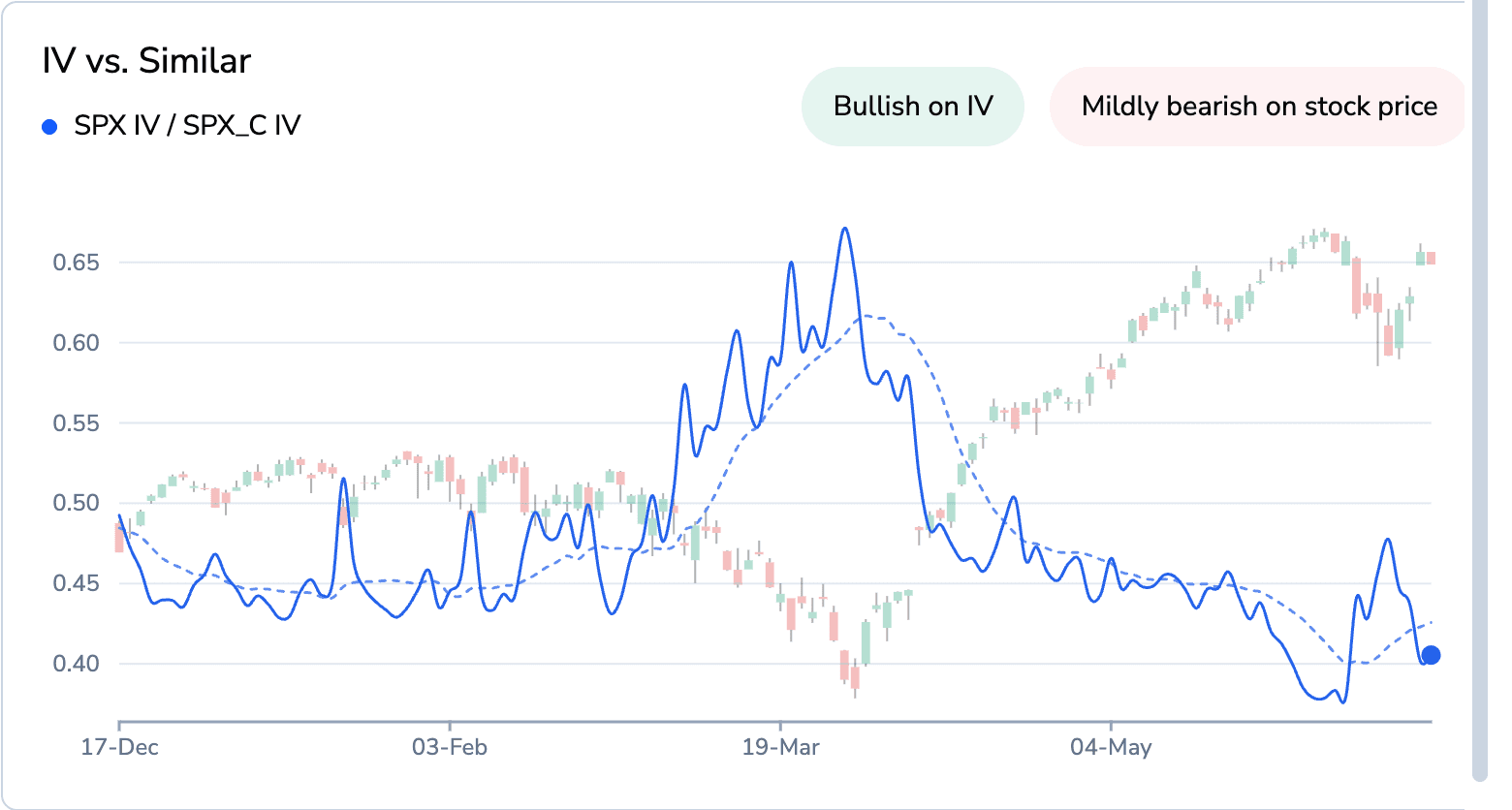
SPX's IV as a ratio to SPX_C, the composite IV of its components
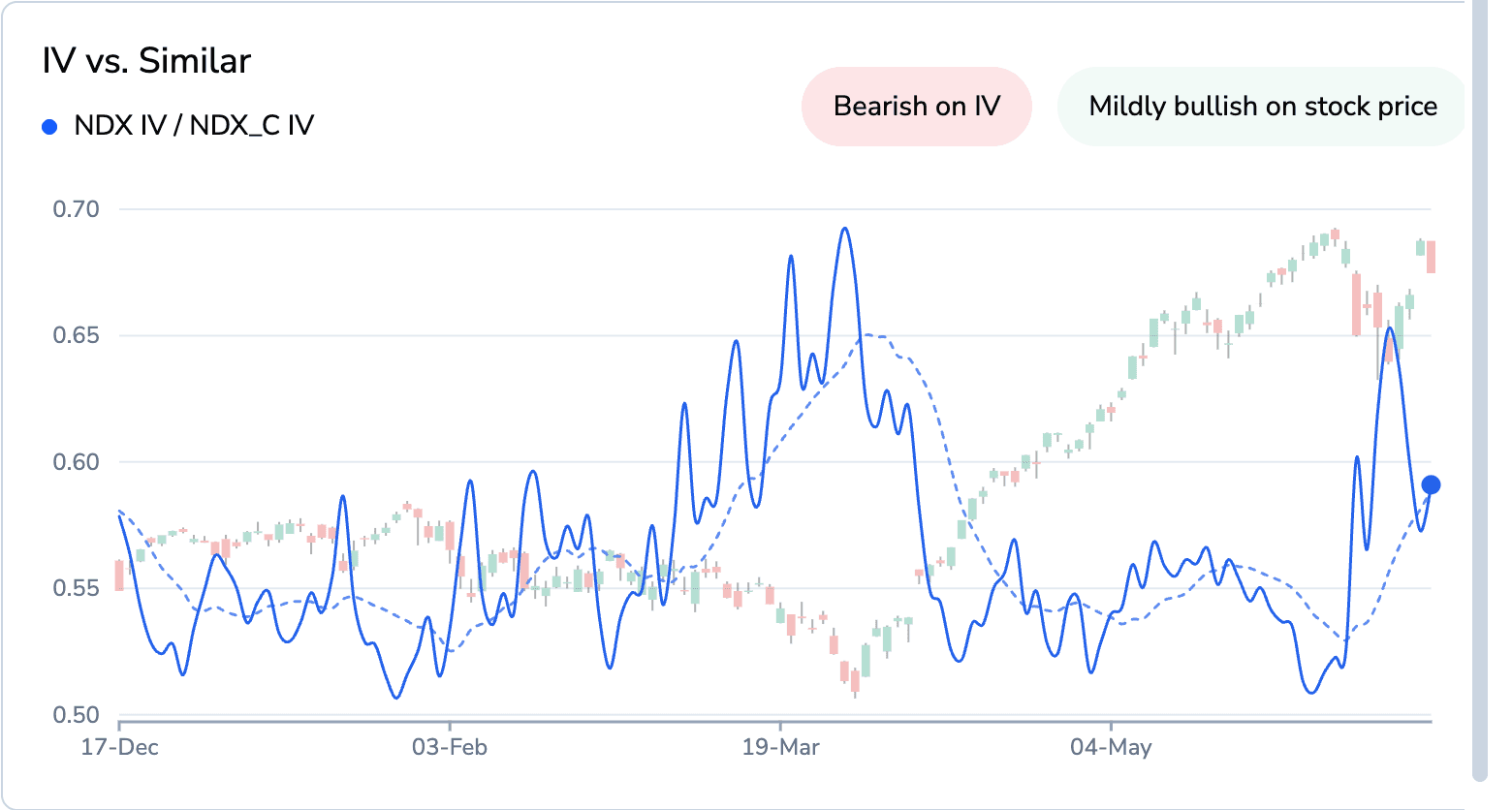
NDX's IV as a ratio to NDX_C, the composite IV of its components
The IV vs. Similar panel from the ORATS dashboard's Outlook tab, SPX on the left and NDX on the right. The solid line is each index's IV as a ratio to the composite IV of its components, with its 10-day average dashed. SPX's ratio climbed during the selloff but from a lower base and to a far lower level. NDX's spiked into the 0.6s, the correlation surge that erased much of its diversification benefit. Captured live intraday June 16 2026, so the right edges sit below the June 9 end-of-day values in the text, after the early-June peak.
The S&P 500: same selloff, milder symptoms
SPX's diversification was dented too: its ratio to SPX_C rose from roughly 0.40 to 0.46 over the same sessions. But it started lower, rose less, and ended far below NDX's 0.63. SPX's 30-day IV closed at 16.3 against NDX's 26.2, putting NDX's vol premium at 1.61x, the 98th percentile of the past year.
The difference is composition. SPX spreads its risk across 500 names and owns low-vol ballast that the Nasdaq-100 lacks entirely: Coca-Cola near 19 vol, J&J at 21, Visa at 23. The Nasdaq-100's top ten names are roughly half the index and concentrate the AI and semiconductor complex, where ex-earnings implied vols run from Nvidia's 40 to Marvell's roughly 105. Fewer effective names, more correlated names: less volatility cancels.
The takeaway
The recent market action exposed a growing concentration risk within the Nasdaq-100 that many investors may underestimate. When a single theme dominates an index, owning 100 tickers is not the same as owning 100 risks, and the moments that prove it are exactly the ones diversification was supposed to protect against.
To reproduce this, pull tradeDate,iv30d for NDX, NDX_C, SPX, and SPX_C from /datav2/hist/summaries and chart the ratios, or open either ticker's Outlook tab on the dashboard.
Disclaimer:
The opinions and ideas presented herein are for informational and educational purposes only and should not be construed to represent trading or investment advice tailored to your investment objectives. You should not rely solely on any content herein and we strongly encourage you to discuss any trades or investments with your broker or investment adviser, prior to execution. None of the information contained herein constitutes a recommendation that any particular security, portfolio, transaction, or investment strategy is suitable for any specific person. Option trading and investing involves risk and is not suitable for all investors.
All opinions are based upon information and systems considered reliable, but we do not warrant the completeness or accuracy, and such information should not be relied upon as such. We are under no obligation to update or correct any information herein. All statements and opinions are subject to change without notice.
Past performance is not indicative of future results. We do not, will not and cannot guarantee any specific outcome or profit. All traders and investors must be aware of the real risk of loss in following any strategy or investment discussed herein.
Owners, employees, directors, shareholders, officers, agents or representatives of ORATS may have interests or positions in securities of any company profiled herein. Specifically, such individuals or entities may buy or sell positions, and may or may not follow the information provided herein. Some or all of the positions may have been acquired prior to the publication of such information, and such positions may increase or decrease at any time. Any opinions expressed and/or information are statements of judgment as of the date of publication only.
Day trading, short term trading, options trading, and futures trading are extremely risky undertakings. They generally are not appropriate for someone with limited capital, little or no trading experience, and/ or a low tolerance for risk. Never execute a trade unless you can afford to and are prepared to lose your entire investment. In addition, certain trades may result in a loss greater than your entire investment. Always perform your own due diligence and, as appropriate, make informed decisions with the help of a licensed financial professional.
Commissions, fees and other costs associated with investing or trading may vary from broker to broker. All investors and traders are advised to speak with their stock broker or investment adviser about these costs. Be aware that certain trades that may be profitable for some may not be profitable for others, after taking into account these costs. In certain markets, investors and traders may not always be able to buy or sell a position at the price discussed, and consequently not be able to take advantage of certain trades discussed herein.
Be sure to read the OCCs Characteristics and Risks of Standardized Options to learn more about options trading.
Related Posts