Backtesting
Wednesday, November 18th 2026
S&P 500 Same-Day Options: Exit Rules Changed Risk and Showed No Measurable Gain
We tested five stops and three profit targets on 1,063 same-day S&P 500 trades.
Summary
We tested five stops and three profit targets on a same-day S&P 500 iron condor over 1,063 trading days with the ORATS Intraday Backtester. Stops made the worst days smaller and profit targets made winning days more common, and no rule changed the average profit by more than chance could explain.
On Thursday, November 5, 2026, the S&P 500 fell about 4% in a single day. A trader who had sold same-day options on the index that morning had to decide whether to close the trade at a loss or hold it until the options expired that afternoon.
Many sellers make that decision in advance with two exit rules. A stop closes the trade once the loss reaches a set size, and a profit target closes it once the profit reaches a set size. We tested five stops and three profit targets on 1,063 days of the same trade. The stops made the worst days smaller and the targets made winning days more common, but no rule changed the average profit by more than chance could explain.
The trade and the two rules
The trade is an iron condor on S&P 500 index options that expire the same day. The seller sells a put below the index and a call above it and collects a premium for both. The seller also buys a put and a call 30 points further out, which caps the loss. If the index stays between the two sold options, the seller keeps the premium, which averaged $931 in our test. Each sold option had about a 30% chance of finishing with value, which traders call a 0.30 delta.
Both rules are set as a percentage of the premium. A stop at 100% closes the trade once the loss equals the premium, and a profit target at 50% closes it once the profit is half the premium.
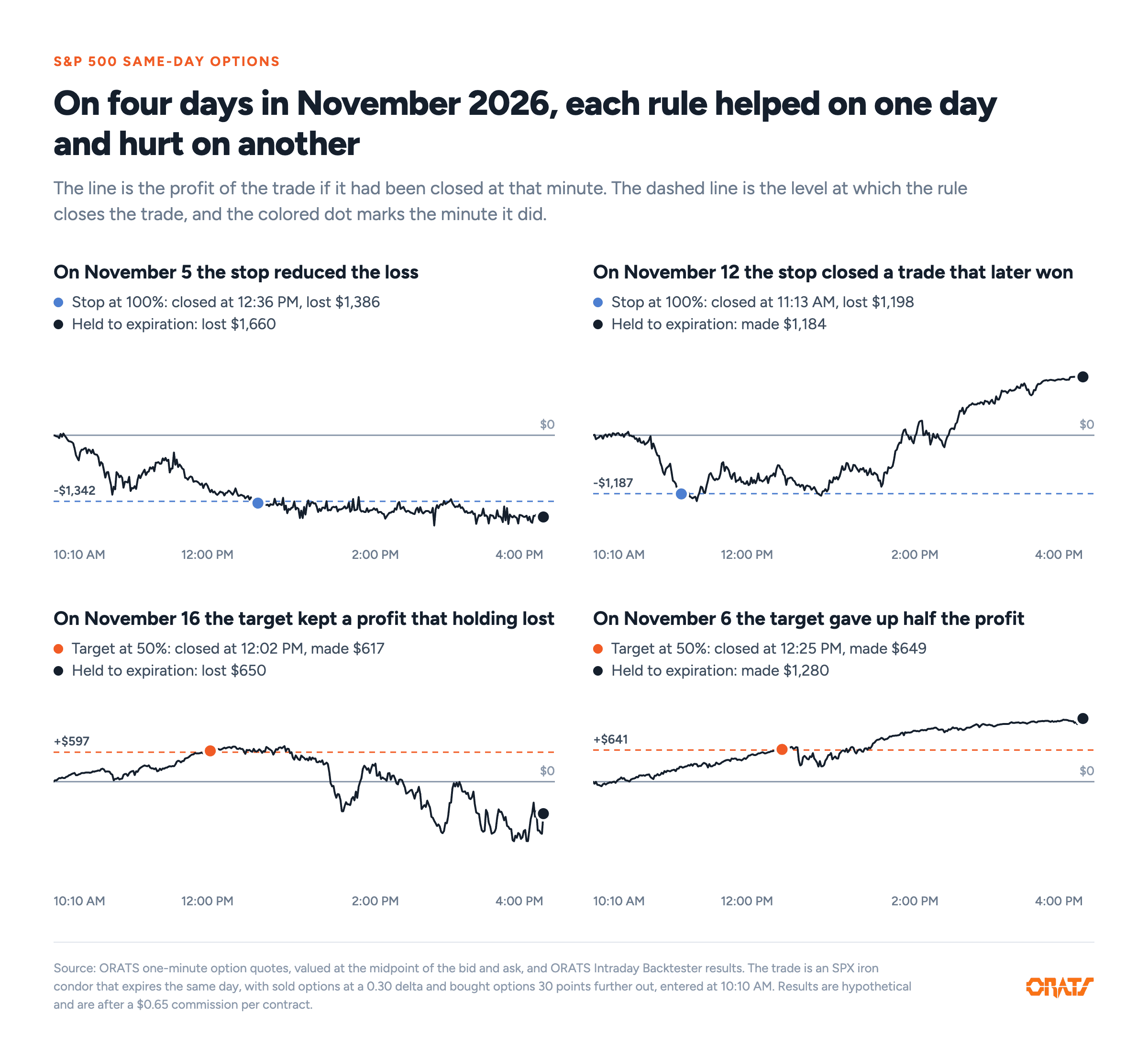
The chart follows the same trade on four days in November 2026. Two days show the stop and two show the profit target. The last point on each line is the result at expiration. Source: ORATS one-minute option quotes and ORATS Intraday Backtester.
On November 5 the stop closed the trade with a loss of $1,386, and holding it lost $1,660. A week later the same stop closed the trade with a loss of $1,198, the index moved back between the sold options, and holding made $1,184. The profit target also helped once and hurt once. Four days cannot show which outcome is more common, so we tested every day since August 2022.
The test
We used the ORATS Intraday Backtester, which replays one-minute option prices and records what a set of rules would have made. It opened the trade at 10:10 AM on 1,063 trading days from August 8, 2022 to November 16, 2026, and it charged a $0.65 commission per option and a fill slightly worse than the middle of the bid and ask. The results are hypothetical.
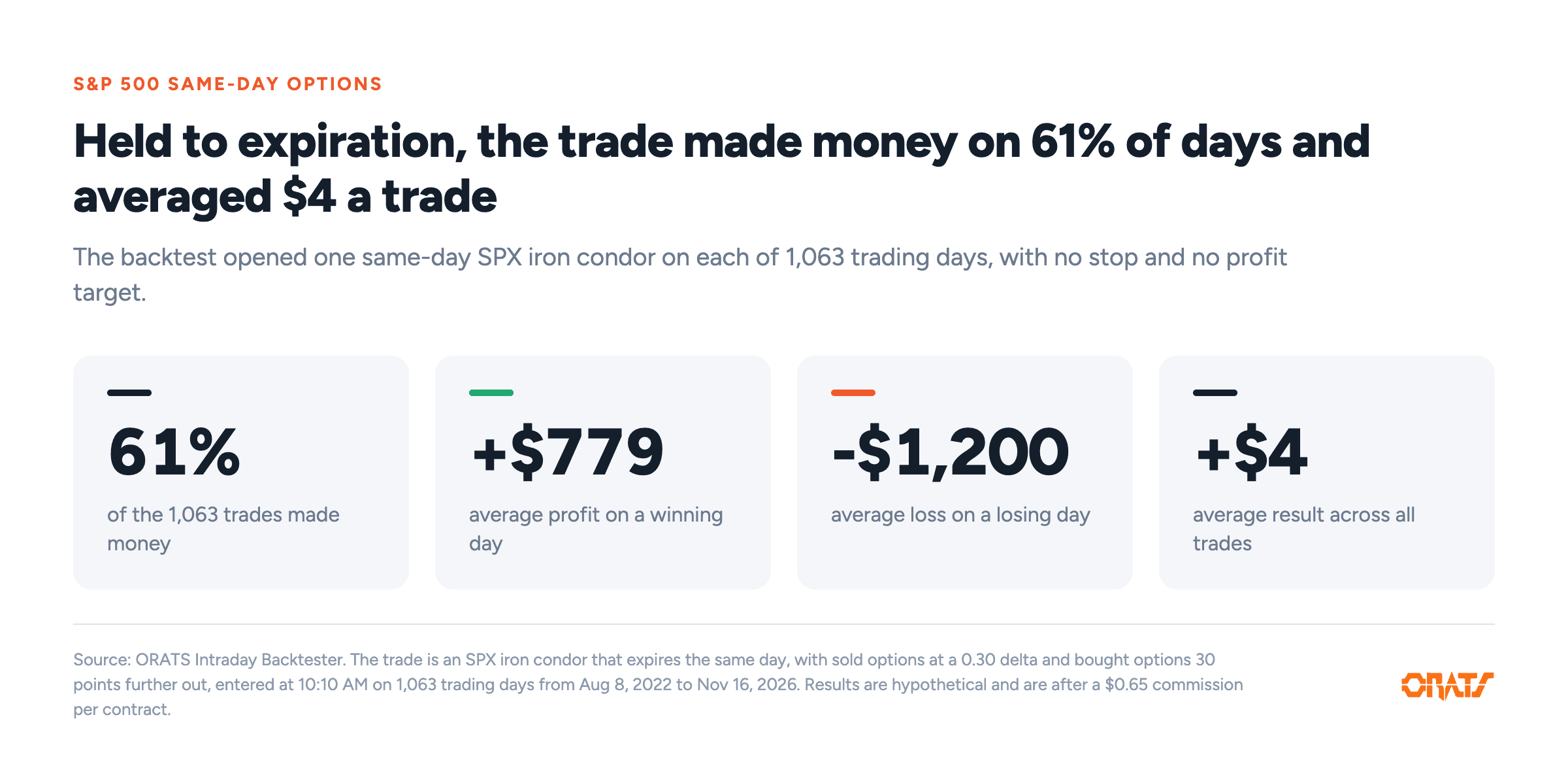
These are the results of the trade with no stop and no profit target. Source: ORATS Intraday Backtester, August 8, 2022 to November 16, 2026.
We then ran the same trades with stops at 50% to 300% of the premium and profit targets at 25% to 75%, so each rule can be compared with holding on the same days.
Stops changed the worst days, and targets changed how often the trade won
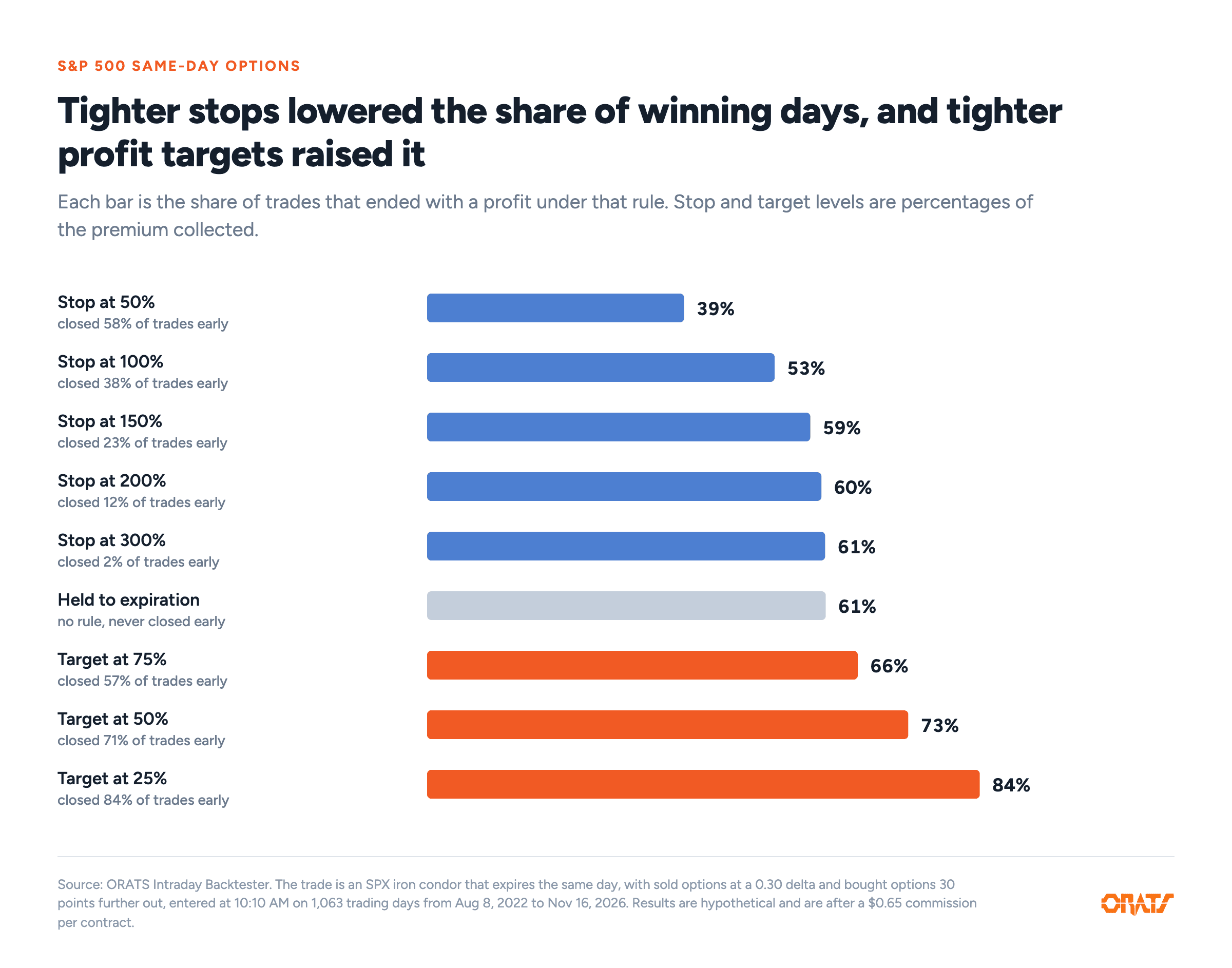
Each bar is the share of trades that ended with a profit. The line under each rule gives how often it closed the trade before expiration. Source: ORATS Intraday Backtester, August 8, 2022 to November 16, 2026.
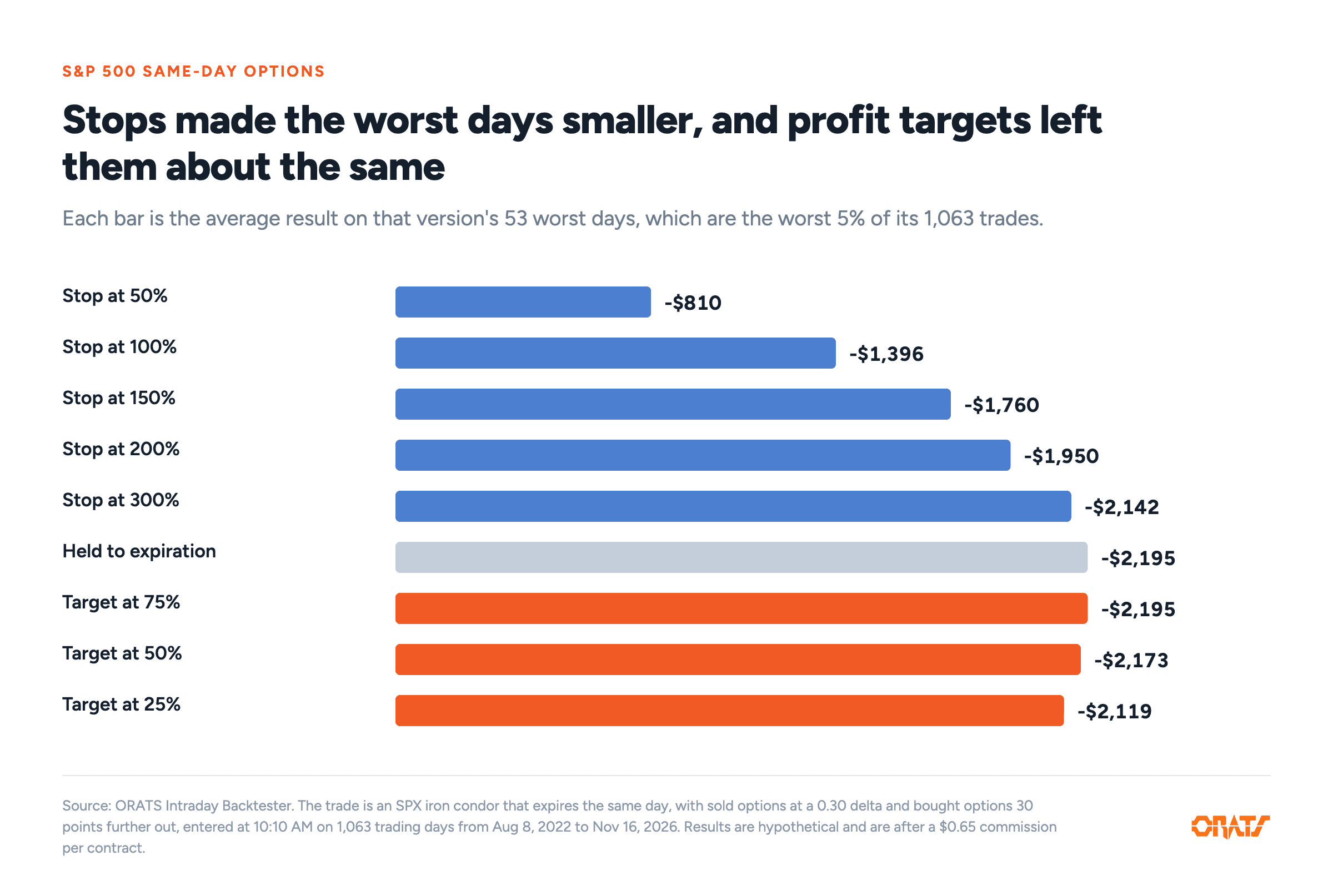
Each bar is the average result on that version's 53 worst days. Source: ORATS Intraday Backtester, August 8, 2022 to November 16, 2026.
A stop can only turn a winning day into a loss, and a target can only do the reverse, so the direction of these changes was certain. The size is what the test measured. A 25% target raised the share of winning days from 61% to 84%, and a 50% stop lowered it to 39%. Stops made the worst days up to 63% smaller. Targets left the worst days about the same, because a target does nothing on a day the trade never reaches it.
The average profit did not change by more than chance
Each rule's result differs from holding by some amount on each day. To see whether the average difference could be chance, we redrew the 1,063 days at random 10,000 times and kept the range that held 95% of the averages.
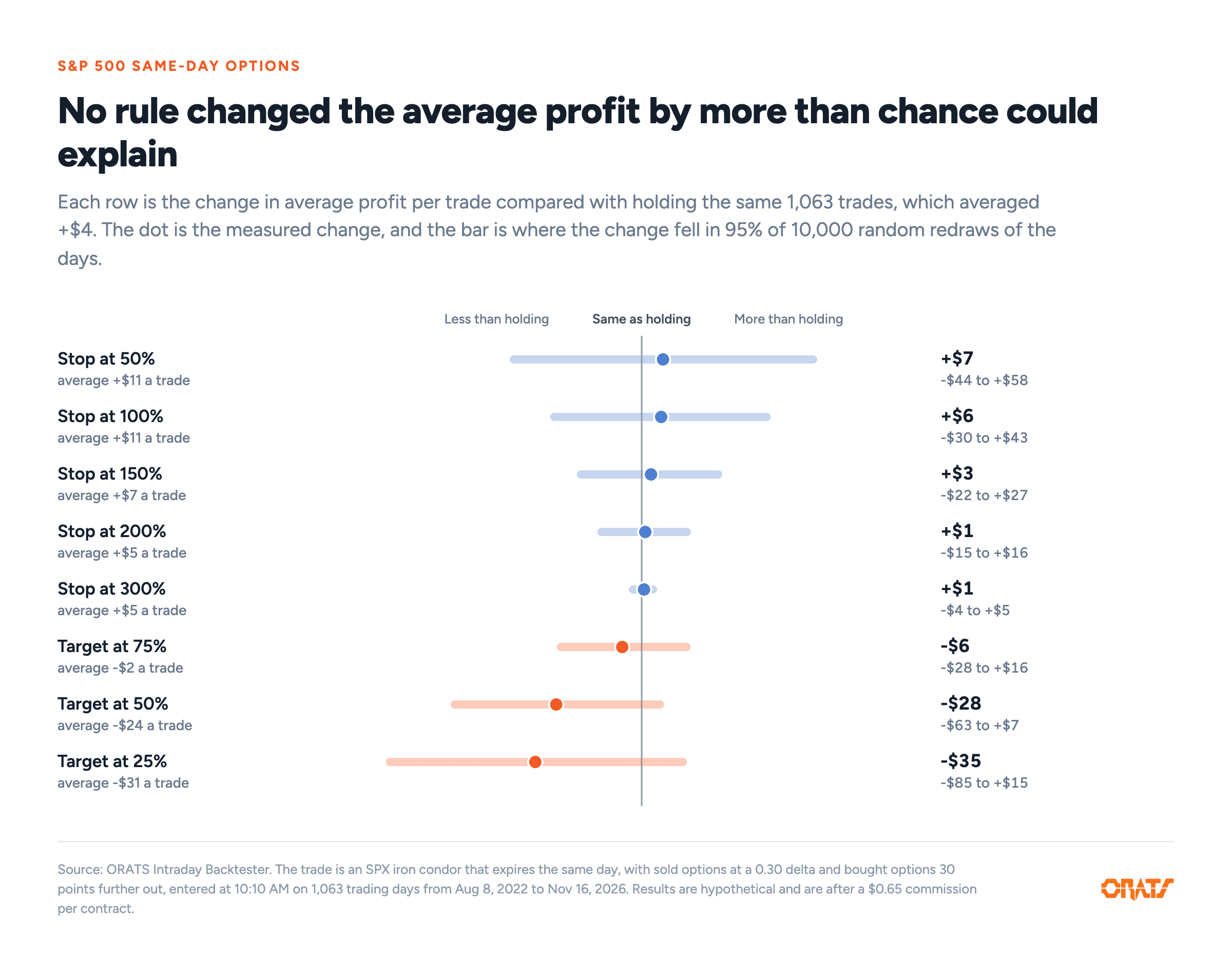
Each dot is the change in average profit per trade compared with holding, and each bar is the range around it. Source: ORATS Intraday Backtester, August 8, 2022 to November 16, 2026.
Every range includes zero. The stops measured $1 to $7 a trade better than holding and the targets $6 to $35 worse, and four years of daily trades cannot separate changes that small from chance.
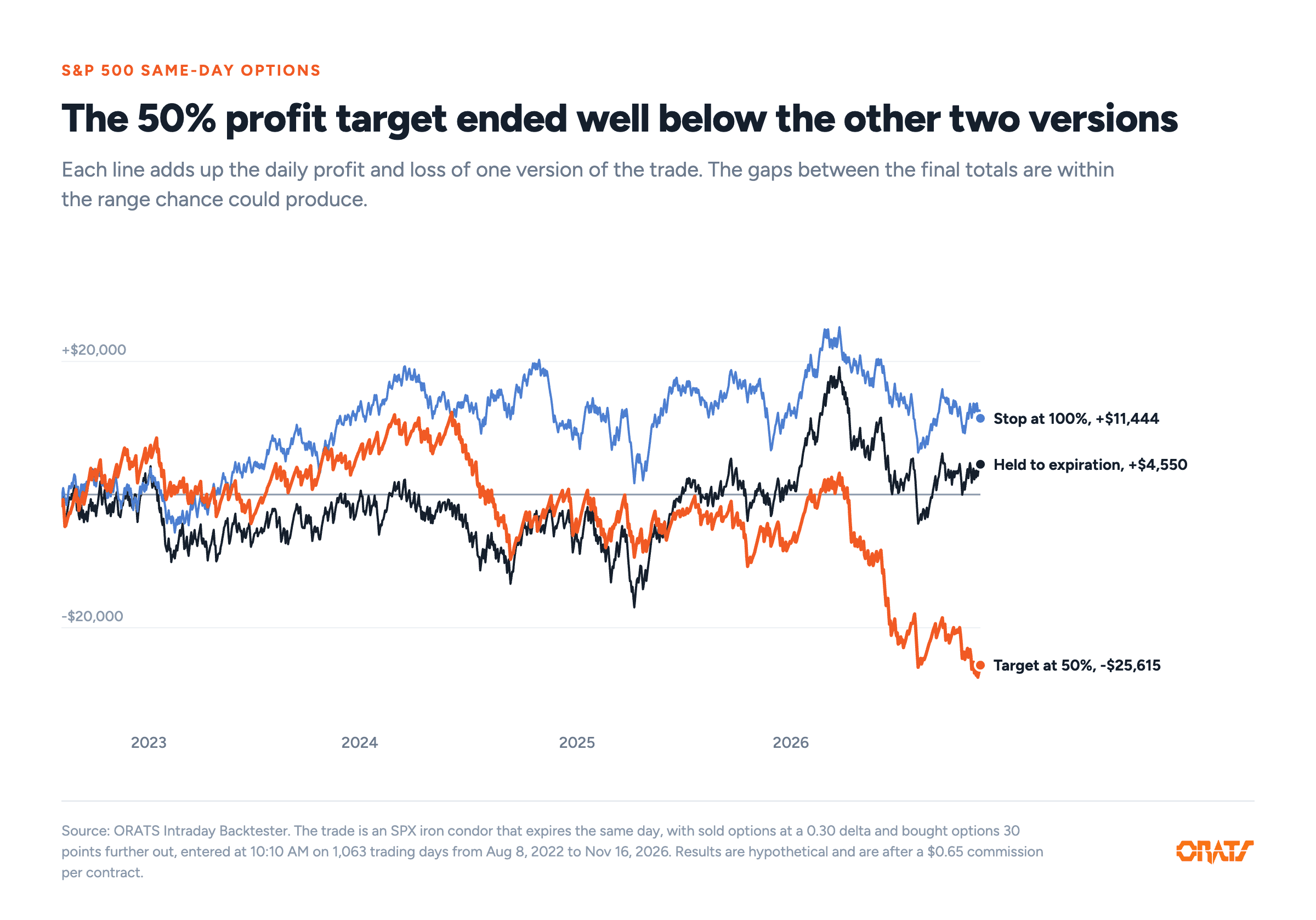
Each line adds up the daily results of one version of the trade. Source: ORATS Intraday Backtester, August 8, 2022 to November 16, 2026.
The 50% target ended about $37,000 behind the 100% stop, which is also within the range of chance. Most of its shortfall came in 2026. On a wider version of the trade, with the sold options at a 0.16 delta, the 50% target lowered the average by $33 a trade, and that was the only one of twelve ranges that excluded zero. That is weak evidence that profit targets cost money on this trade, and it is not proof.
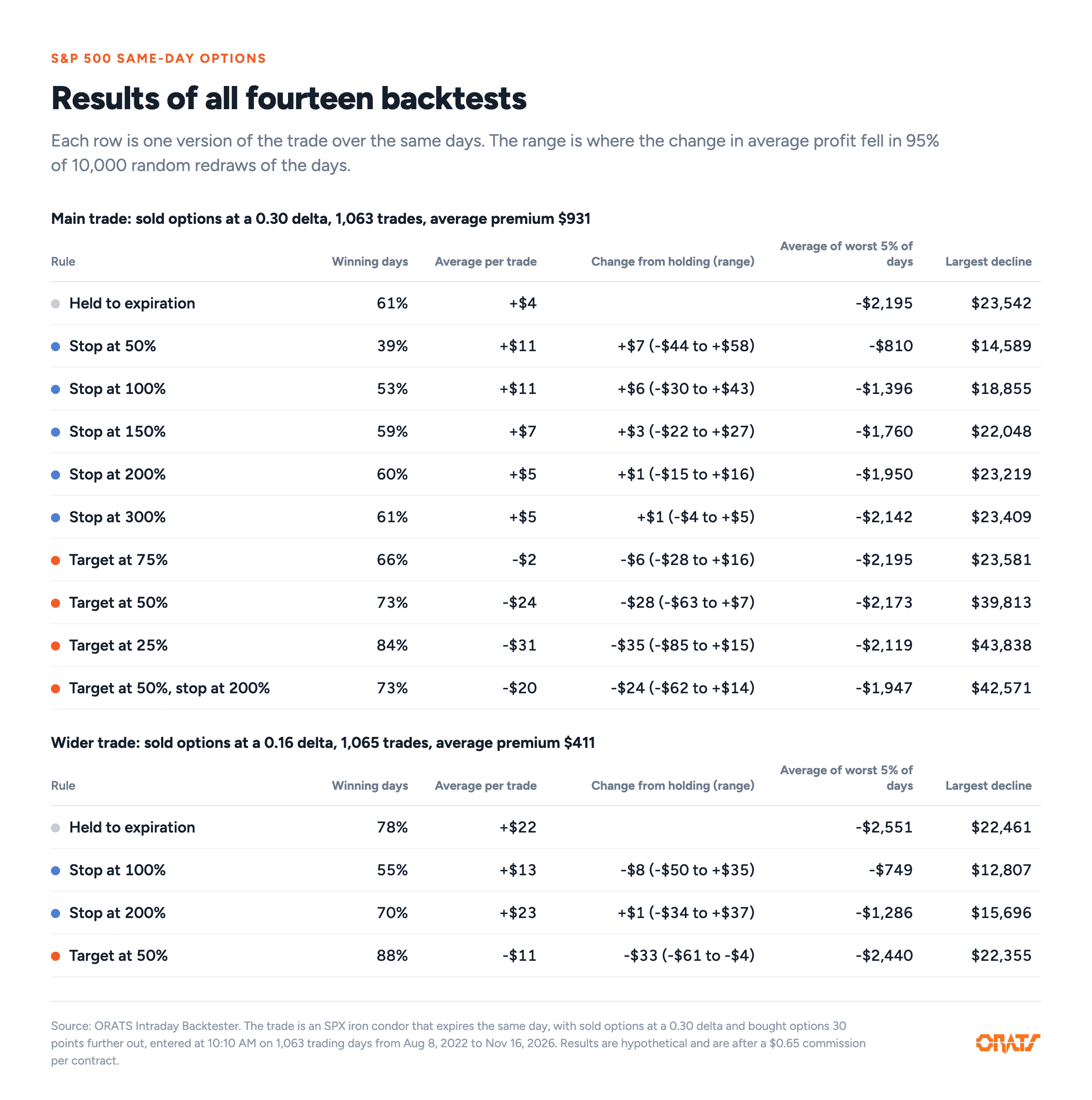
The table gives every version of both trades. The last row of the main trade uses a 50% target and a 200% stop together, and it behaved like the 50% target alone. The largest decline is the biggest fall of a running total from a high point. Source: ORATS Intraday Backtester, August 8, 2022 to November 16, 2026.
In this test a stop chose the size of the worst days and a target chose how often the trade won, and neither changed what the trade earned. The test covers one index, one entry time and four years, and it does not include exchange fees.
How to repeat the test
In the ORATS dashboard, choose Backtesting, then Custom Backtester, then Intraday, and enter the settings below. Each run takes about ten minutes.
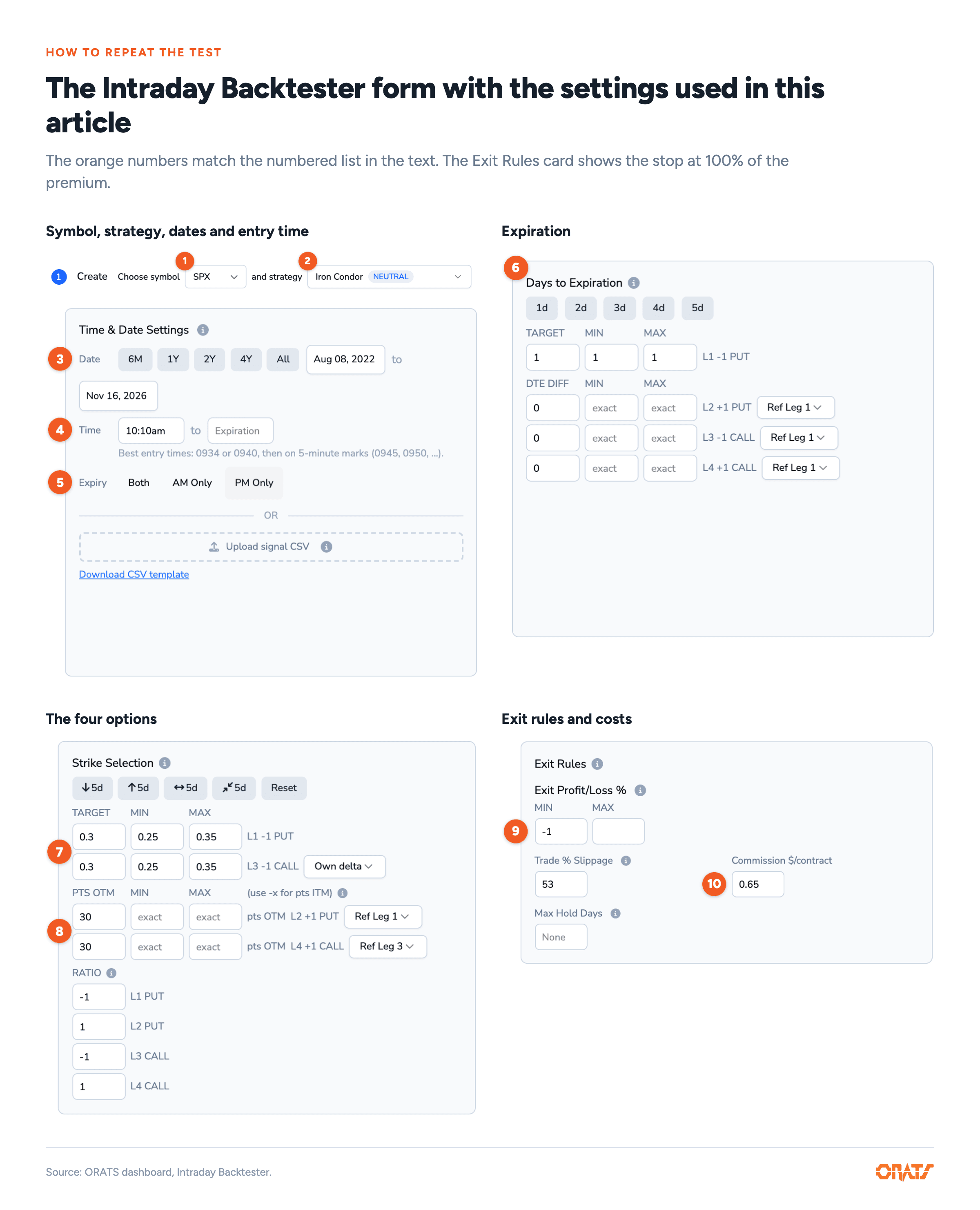
The orange numbers match the list below.
- Symbol: SPX
- Strategy: Iron Condor
- Date: Aug 08, 2022 to Nov 16, 2026
- Time: 10:10am to Expiration
- Expiry: PM Only
- Days to Expiration: 1, which is the same day
- Sold put and sold call: TARGET 0.3, MIN 0.25, MAX 0.35
- Bought put and bought call: 30 in PTS OTM
- Exit Profit/Loss %: a stop as a negative fraction in MIN (-1 is a 100% stop), a target as a positive fraction in MAX (0.5 is a 50% target), or both empty to hold
- Commission $/contract: 0.65
Leave the other settings as they are.
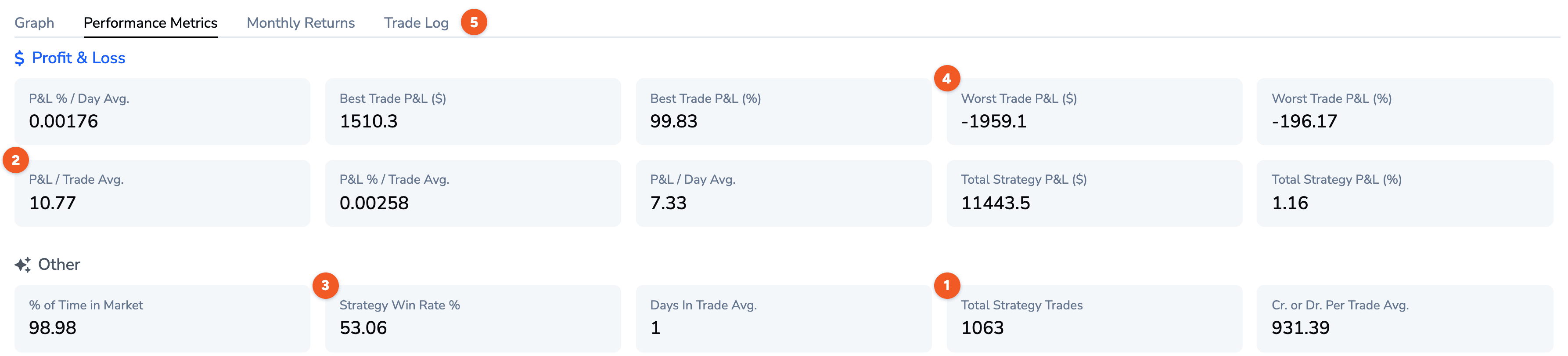
The screenshot shows the results for the 100% stop. P&L means profit and loss. The numbers mark (1) the number of trades, (2) the average profit per trade, (3) the share of winning trades, (4) the worst trade and (5) the trade log.
Held to expiration should show 1063 trades, a P&L / Trade Avg. of 4.28 and a Strategy Win Rate % of 60.87. The 100% stop should show 10.77 and 53.06. The Intraday Backtester API takes the same settings, with the stop and target as whole percents in stopLossPct and profitTargetPct.
You can run this comparison on your own trade with the ORATS Intraday Backtester.
Tyler Cheves is a Product Manager at ORATS (Option Research & Technology Services), a provider of options data, analytics, and backtesting infrastructure.
For educational purposes only and not a recommendation. ORATS data is as of November 17, 2026. Backtested results are hypothetical. They cover 1,063 trades entered at 10:10 AM from August 8, 2022 to November 16, 2026, with a $0.65 commission per contract, fills 53% of the way across the bid and ask, and no exchange fees. Fourteen backtests are reported. The largest decline of a running total was $43,838, and the largest loss on one trade was $2,771. Past performance does not guarantee future results.
Options involve risk and are not suitable for all investors. An iron condor can lose much more than the premium received. See Characteristics and Risks of Standardized Options at theocc.com. The Intraday Backtester depends on your ORATS plan. S&P 500 is a registered trademark of Standard & Poor's Financial Services LLC.
Disclaimer:
The opinions and ideas presented herein are for informational and educational purposes only and should not be construed to represent trading or investment advice tailored to your investment objectives. You should not rely solely on any content herein and we strongly encourage you to discuss any trades or investments with your broker or investment adviser, prior to execution. None of the information contained herein constitutes a recommendation that any particular security, portfolio, transaction, or investment strategy is suitable for any specific person. Option trading and investing involves risk and is not suitable for all investors.
All opinions are based upon information and systems considered reliable, but we do not warrant the completeness or accuracy, and such information should not be relied upon as such. We are under no obligation to update or correct any information herein. All statements and opinions are subject to change without notice.
Past performance is not indicative of future results. We do not, will not and cannot guarantee any specific outcome or profit. All traders and investors must be aware of the real risk of loss in following any strategy or investment discussed herein.
Owners, employees, directors, shareholders, officers, agents or representatives of ORATS may have interests or positions in securities of any company profiled herein. Specifically, such individuals or entities may buy or sell positions, and may or may not follow the information provided herein. Some or all of the positions may have been acquired prior to the publication of such information, and such positions may increase or decrease at any time. Any opinions expressed and/or information are statements of judgment as of the date of publication only.
Day trading, short term trading, options trading, and futures trading are extremely risky undertakings. They generally are not appropriate for someone with limited capital, little or no trading experience, and/ or a low tolerance for risk. Never execute a trade unless you can afford to and are prepared to lose your entire investment. In addition, certain trades may result in a loss greater than your entire investment. Always perform your own due diligence and, as appropriate, make informed decisions with the help of a licensed financial professional.
Commissions, fees and other costs associated with investing or trading may vary from broker to broker. All investors and traders are advised to speak with their stock broker or investment adviser about these costs. Be aware that certain trades that may be profitable for some may not be profitable for others, after taking into account these costs. In certain markets, investors and traders may not always be able to buy or sell a position at the price discussed, and consequently not be able to take advantage of certain trades discussed herein.
Be sure to read the OCCs Characteristics and Risks of Standardized Options to learn more about options trading.
Related Posts