Trading
Wednesday, January 7th 2026
What Is a Volatility Surface? Why Traders Use It
A framework for evaluating options pricing using term structure and strike structure
Summary
Implied volatility is not a single number but varies across time and strike prices, forming a volatility surface. Term structure shows how implied volatility changes with expiration dates, typically increasing for longer-term options. Strike structure, or skew, indicates that lower strikes often have higher implied volatility due to demand for downside protection. ORATS analyzes these structures to help traders assess whether options are overpriced or underpriced relative to historical norms, emphasizing the importance of context in evaluating risk pricing.
Implied volatility is usually quoted as a single number. That number is convenient, but it’s incomplete.
Options are not priced with one volatility.
They are priced across time and across strike.
That structure is what traders refer to as the volatility surface.
In practice, the volatility surface is best understood by breaking it into two components that actually matter for decision-making: term structure and strike structure. Everything else is visualization.
Term Structure: How Volatility Is Priced Across Time
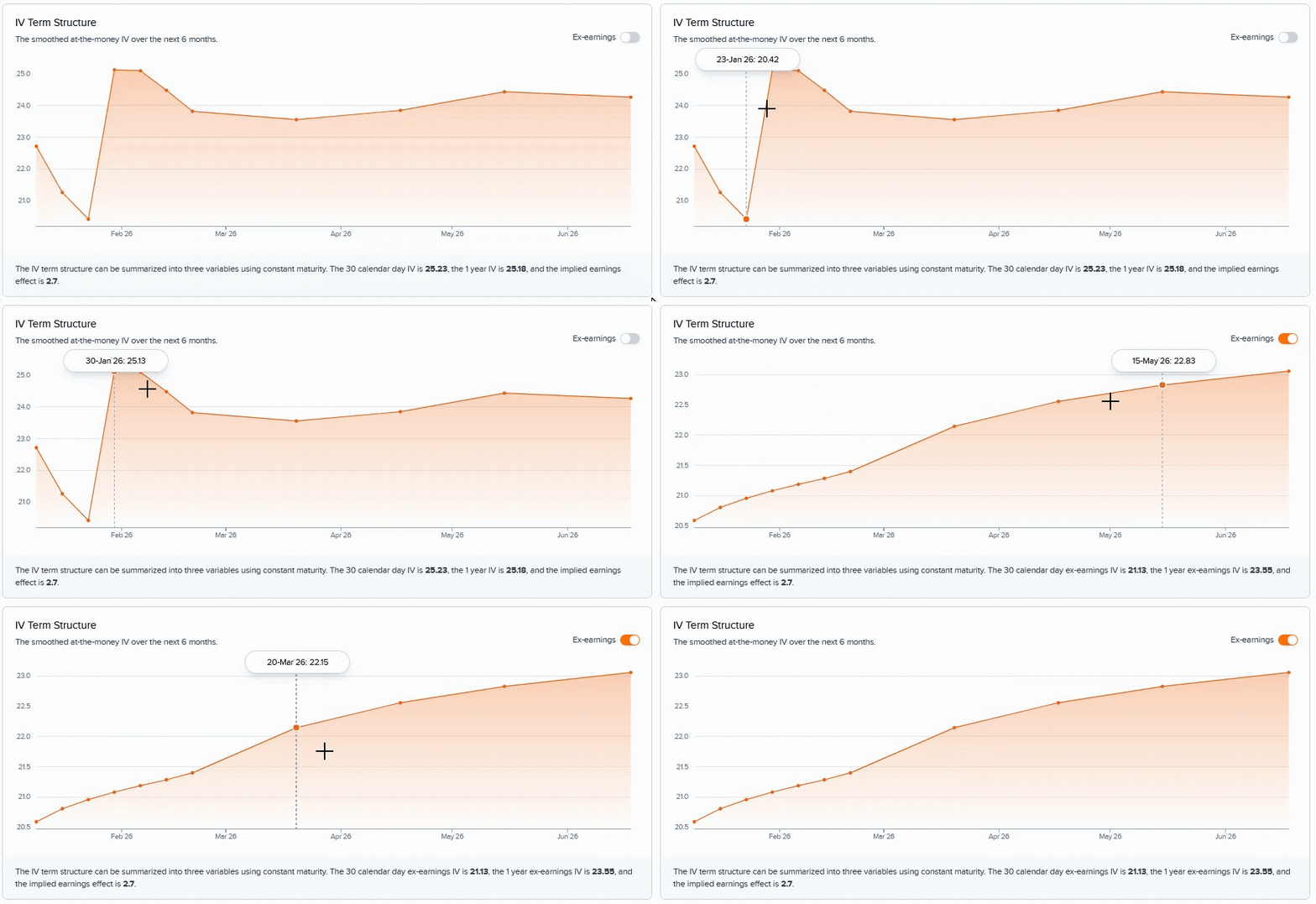
Term structure describes how implied volatility changes across expirations, from short-dated options to longer-dated contracts.
In normal markets, short-term options trade at lower implied volatility than longer-term options. This upward-sloping structure is commonly referred to as contango. It reflects the idea that uncertainty increases with time.
During periods of stress, this relationship can invert. Short-term volatility can rise above long-term volatility, a condition known as backwardation. When this occurs, the market is signaling that risk is concentrated in the near term rather than spread evenly across time.
ORATS evaluates term structure by comparing short-dated implied volatility, typically under forty-five days, against longer-term baselines. Short-dated volatility reacts first and most aggressively to changes in sentiment, which makes this part of the curve especially informative.
By standardizing implied volatility at fixed time horizons, ORATS allows traders to compare volatility consistently across different stocks. This makes it possible to determine whether near-term options are expensive or cheap relative to longer-term expectations.
Strike Structure: How Volatility Is Priced Across Risk
Strike structure describes how implied volatility varies across strikes for a given expiration. This is often referred to as skew or the volatility smile.
In equity markets, lower strikes usually trade at higher implied volatility than higher strikes. This reflects persistent demand for downside protection.
Many platforms display skew using raw strike prices on the horizontal axis. While intuitive, this approach makes meaningful comparison difficult. A one-hundred-dollar strike may be at-the-money for one stock and deep in-the-money for another.
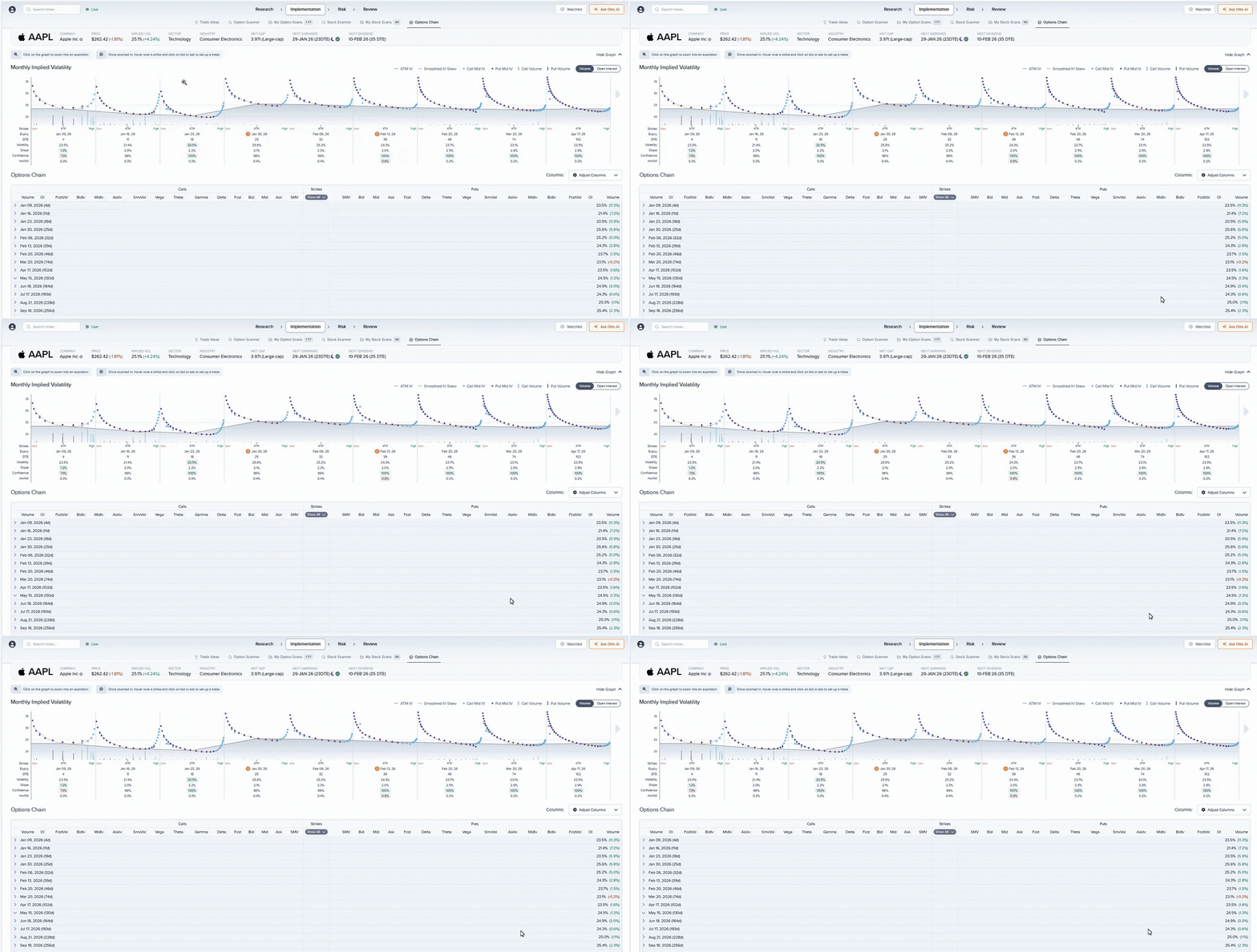
ORATS normalizes strike structure using delta.
Delta represents comparable risk exposure across different stocks, price levels, and expirations. A twenty-five-delta put represents similar downside exposure regardless of the underlying. This normalization allows traders to compare skew across tickers and sectors.
Slope: Quantifying Skew
To quantify strike structure, ORATS focuses on slope.
Slope measures how quickly implied volatility increases as you move from at-the-money options toward lower-strike puts. A steeper slope indicates that downside protection is expensive relative to at-the-money options. A flatter slope indicates that downside protection is cheaper.
ORATS places slope in context using slope percentile. This shows where today’s slope ranks relative to its own history.
A steep slope is not meaningful on its own. What matters is whether it is steep relative to what is normal for that asset.
For example, if a stock’s slope is in the ninetieth percentile, downside protection is more expensive than in ninety percent of historical observations, even if overall implied volatility appears average. That context changes how a trader should evaluate structures like put spreads, collars, or risk reversals.
ORATS also calculates curvature, sometimes referred to as derivative, which measures how the slope itself changes further away from at-the-money. This can be informative, but it is a second-order effect. For most analysis, slope carries the primary signal.
Context, Not Prediction
Volatility surfaces are not predictive. They do not tell you where price will go.
They describe how risk is being priced.
ORATS evaluates that pricing through structure, history, and relative comparison, including comparisons between individual stocks and sector or index composites. These comparisons help distinguish stock-specific pricing from broader market conditions.
The volatility surface is not a chart.
It is a framework.
Term structure explains how volatility is priced across time.
Strike structure explains how volatility is priced across risk.
Together, they explain why implied volatility cannot be evaluated in isolation and why context matters.
That is how ORATS approaches volatility.
Disclaimer:
The opinions and ideas presented herein are for informational and educational purposes only and should not be construed to represent trading or investment advice tailored to your investment objectives. You should not rely solely on any content herein and we strongly encourage you to discuss any trades or investments with your broker or investment adviser, prior to execution. None of the information contained herein constitutes a recommendation that any particular security, portfolio, transaction, or investment strategy is suitable for any specific person. Option trading and investing involves risk and is not suitable for all investors.
All opinions are based upon information and systems considered reliable, but we do not warrant the completeness or accuracy, and such information should not be relied upon as such. We are under no obligation to update or correct any information herein. All statements and opinions are subject to change without notice.
Past performance is not indicative of future results. We do not, will not and cannot guarantee any specific outcome or profit. All traders and investors must be aware of the real risk of loss in following any strategy or investment discussed herein.
Owners, employees, directors, shareholders, officers, agents or representatives of ORATS may have interests or positions in securities of any company profiled herein. Specifically, such individuals or entities may buy or sell positions, and may or may not follow the information provided herein. Some or all of the positions may have been acquired prior to the publication of such information, and such positions may increase or decrease at any time. Any opinions expressed and/or information are statements of judgment as of the date of publication only.
Day trading, short term trading, options trading, and futures trading are extremely risky undertakings. They generally are not appropriate for someone with limited capital, little or no trading experience, and/ or a low tolerance for risk. Never execute a trade unless you can afford to and are prepared to lose your entire investment. In addition, certain trades may result in a loss greater than your entire investment. Always perform your own due diligence and, as appropriate, make informed decisions with the help of a licensed financial professional.
Commissions, fees and other costs associated with investing or trading may vary from broker to broker. All investors and traders are advised to speak with their stock broker or investment adviser about these costs. Be aware that certain trades that may be profitable for some may not be profitable for others, after taking into account these costs. In certain markets, investors and traders may not always be able to buy or sell a position at the price discussed, and consequently not be able to take advantage of certain trades discussed herein.
Be sure to read the OCCs Characteristics and Risks of Standardized Options to learn more about options trading.
Related Posts